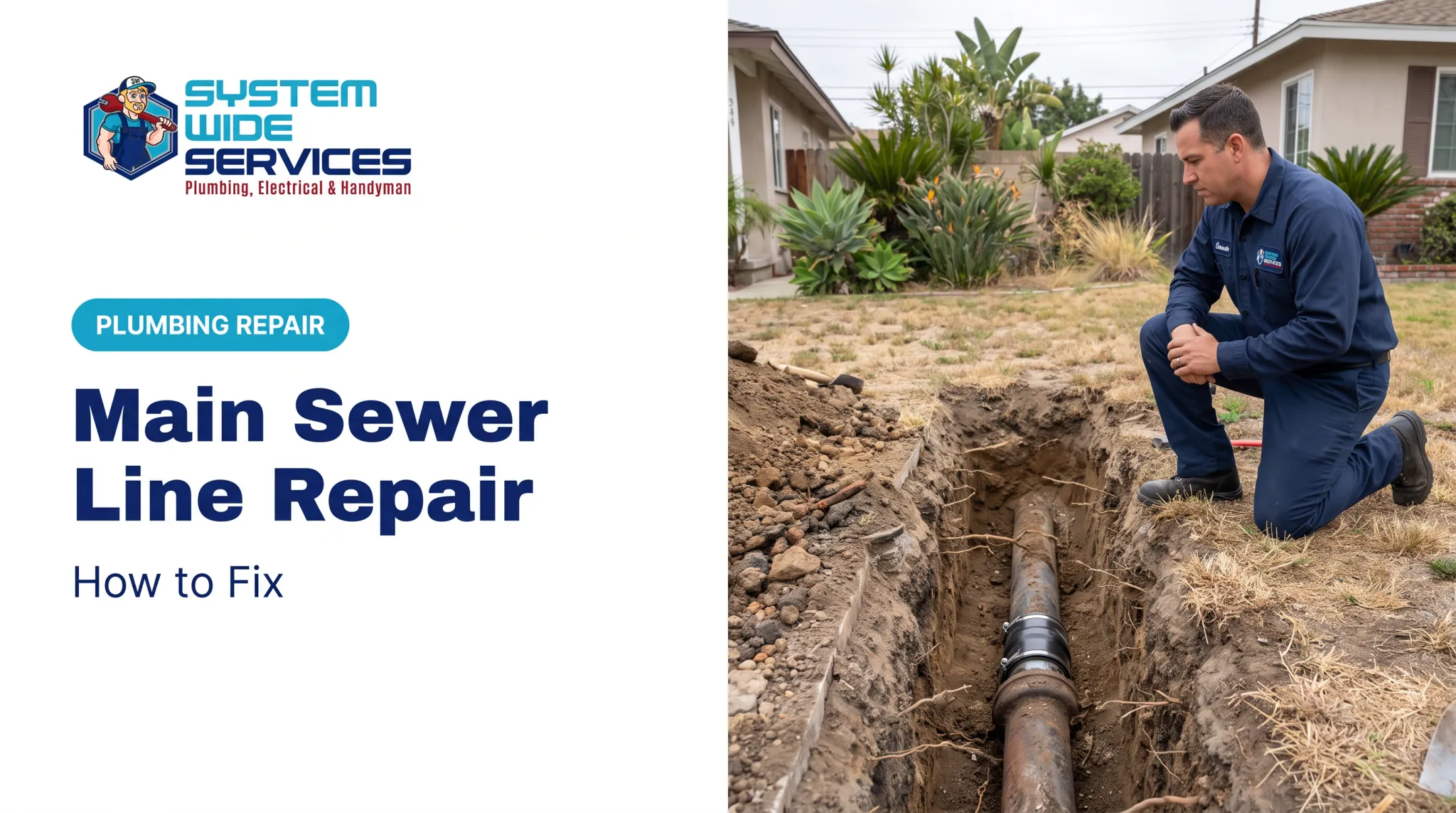

The final price depends on the type and severity of damage, pipe length and material, access, repair method, permits, labor, and restoration. Published guides disagree on scope, so a single "average" can mislead.
This article compares current US price ranges, explains the main cost components, shows when trenchless repair may fit, and walks through how to evaluate an estimate.
Key Takeaways
- Published guides put general repairs at roughly $1,100 to $4,100, while full replacements climb much higher.
- Damage extent, length, depth, access, method, permits, and restoration drive the price.
- Collapsed lines, long runs, and hardscape push costs up; short, accessible repairs stay low.
- A camera inspection and proper restoration lower the odds of paying twice.
How Much Does Sewer Line Repair Cost? (Pricing Overview)
There is no fixed national price. The honest answer comes from an on-site camera inspection and a written quote. Published benchmarks give you a starting frame, nothing more.
Misreading the cost causes real trouble:
- Underbudgeting because excavation, permits, cleanup, or landscaping were left out
- Choosing relining or a spot repair when the pipe is collapsed or badly misaligned
- Accepting a low price that excludes restoration, disposal, warranty terms, or follow-up work
Typical Cost Range
Consumer guides define scope differently, so treat these as separate benchmarks rather than one market average. Angi's July 2026 guide lists general sewer repair at an average of about $2,600, with a range of $1,100 to $4,100.
Entry-level or localized repair
This tier covers diagnosis followed by a limited, accessible fix, such as a short section or a root-related correction. Drain cleaning is a different service from structural repair.
- HomeGuide lists general repairs at $150 to $3,800
- HomeAdvisor lists a broken or cracked pipe at $600 to $1,050
No guide defines a standard spot-repair scope. Camera inspection, permits, excavation, surface restoration, sewage cleanup, and unrelated plumbing work are often excluded, so confirm line items before you sign.
Mid-range or standard repair
This tier usually means a longer partial replacement, harder access, or a trenchless liner in a pipe that is still structurally sound.
- Partial replacement: $50 to $250 per foot (HomeAdvisor)
- Cured-in-place pipe (CIPP) lining: $80 to $250 per foot, with Angi reporting an average project near $9,000
- Pipe bursting: $60 to $200 per foot
Angi's separate trenchless lining page shows $1,900 to $6,000 per project, and its project and per-foot figures don't reconcile. That's a good reminder to compare quotes line by line.
High-end or extensive replacement
HomeGuide's 2025 data puts full replacement at $50 to $250 per linear foot, or $2,000 to $10,000 for about 40 feet, with a stated maximum near $20,000. HomeAdvisor's estimate is lower, at $1,388 to $5,323.

What pushes a job toward the top:
- A collapsed or very long lateral
- Deep excavation or work under a slab or driveway
- A public connection, utility coordination, or right-of-way requirements
- Disposal, landscaping, hardscape, and sewage remediation
Key Factors That Affect Sewer Line Repair Cost
Sewer line repair cost depends on technical, site-specific, regulatory, and restoration factors. Labor and pipe materials are only part of the bill.
Repair Method
Common options include:
- Spot repair or partial replacement for limited damage
- CIPP lining, a resin-saturated tube cured inside the old pipe
- Pipe bursting, which breaks the old pipe outward while pulling new pipe behind it
- Conventional trench-and-replace when full excavation is required
A cheaper repair isn't always better value. If the rest of the line is deteriorated or roots keep returning, you may pay for the same section twice.
Length, Depth, and Scale
More footage, larger diameter, greater depth, and more connections mean more labor, equipment, and time. Traditional trenching alone runs about $5 to $12 per foot, depending on depth and obstacles.
Contractors may quote per project, per foot, or both. Don't compare per-foot numbers until you know what each quote includes.
Damage Type and Pipe Condition
Cracks, separated joints, corrosion, roots, bellies, misalignment, and collapse each limit the options.
Old cast iron can corrode and lose internal diameter. Orangeburg can deform and collapse, according to a Santa Barbara city glossary.
A camera inspection should confirm whether the damage is localized and whether the pipe can hold a liner. Trenchless options generally require a pipe that has not collapsed.
Location and Surface Restoration
A line under a lawn is cheaper to reach and restore than one under a driveway, slab, patio, or street. Concrete removal runs about $3 to $8 per square foot extra. Soil, depth, confined access, utility conflicts, and weather all add to the bill.
Materials, Codes, and Permits
Older materials cut and join differently than modern PVC, which affects labor and parts. Permit rules also vary. Santa Cruz County, for example, requires a plumbing permit for drainage piping that is repaired or replaced. California's 2025 plumbing code cycle took effect January 1, 2026, so confirm local requirements before work starts.
Diagnosis, Labor, and Urgency
Charges that often appear on an estimate include:
- Video inspection, locating, and cleaning
- Skilled labor, permits, and disposal
- Emergency scheduling for urgent calls
Urgent stabilization or sewage response is separate from the permanent repair. Ask which charges the written quote covers.
Sewer Line Repair Cost Breakdown
Look past the visible pipe work. Review the project as one-time, conditional, and recurring items.
| Cost item | Timing | Published benchmark |
|---|---|---|
| Camera inspection and prep | Usually one-time | $100 to $500 |
| Repair, replacement, or lining | One-time | $50 to $250 per foot |
| Excavation and restoration | One-time or conditional | $5 to $12 per foot trenching; $3 to $8 per sq. ft. concrete |
| Permits and disposal | One-time or conditional | Permit about $200 to $1,000 |
| Cleanup and future care | Conditional or recurring | Cleanup $500 to $10,000 |

Inspection, Diagnosis, and Preparation
Expect camera inspection, line locating, damage documentation, and root removal or cleaning before repair. Ask whether the inspection fee is credited toward the repair. HomeAdvisor and HomeGuide put cameras at $100 to $500; a post-replacement inspection may add $175 to $350.
Repair, Replacement, or Lining Work
This covers pipe, fittings, liner material, labor, equipment, connections, and testing. A targeted fix of a few feet is a different job from replacing a run from house to street.
Excavation, Access, and Restoration
Trenching, shoring, slab or driveway removal, backfill, concrete or asphalt, landscaping, and interior finishes all fit here. Angi lists driveway repair at $799 to $2,603 and landscaping restoration at $300 to $10,000.
Permits, Disposal, and Right-of-Way
Permits, inspections, old-pipe disposal, and street or sidewalk work can be separate line items. Find out whether the affected section is private or part of the public main. In Los Angeles, owners maintain both the upper and lower lateral, but work in the public right-of-way needs a Class A permit from the Bureau of Engineering.
Cleanup, Maintenance, and Future Repairs
Sewage cleanup and water-damage restoration are not plumbing repair. Budget for future camera checks and root management too. Insurance rarely covers this by default: Texas's consumer counsel notes service-line coverage is usually optional, and New York's regulator describes sewer backup as an add-on. Check your own policy.
How to Estimate the Right Sewer Line Repair Budget
Base your budget on the confirmed condition of the line and the full scope of work, not the lowest advertised price.
- Get a camera inspection and written diagnosis showing location, length, severity, and damage type. Ask for the video or images.
- Confirm the scope. Does the proposal cover the whole lateral or only one section? Get depth, access, material, connections, permits, cleanup, restoration, testing, and warranty in writing.
- Compare methods on suitability, not just price. Weigh disruption, service life, and whether the line suits trenchless work. NASSCO's 2023 specification calls for CIPP designed for a 50-year-plus life with a one-year contractor warranty. That is a spec, not a guarantee for every home.
- Ask for an itemized estimate separating included work from allowances, exclusions, possible change orders, and restoration by others.
- Set a reserve for surprises without accepting an open-ended contingency. Before you sign, verify license, insurance, references, and who pulls the permits.

Low-Cost vs High-Cost Sewer Line Repair: What's the Difference?
Price alone doesn't prove quality or fit. A limited repair and a full replacement solve different problems.
| Lower-cost repair | Higher-cost repair | |
|---|---|---|
| Suitability | Fixes a localized defect when the rest of the line is sound | Handles widespread deterioration, collapse, or long sections |
| Durability | Risk of repeat problems if only the symptom is treated | Broader coverage; confirm warranty terms in writing |
| Disruption | Less digging, smaller bill now | More cost and disruption up front |
| Long-term value | May not avoid future access and restoration costs | Can prevent repeated repairs |

Either choice should rest on inspection findings, not a salesperson's preference.
What Most People Miss
- Focusing only on pipe work while overlooking diagnosis, permits, excavation, restoration, cleanup, disposal, and right-of-way rules
- Treating a recurring backup as a clog without checking for roots, cracks, corrosion, a belly, or collapse
- Picking the cheapest quote without comparing scope, licensing, insurance, warranty, materials, testing, and exclusions
Conclusion
Sewer line repair costs vary widely based on damage, pipe length and condition, access, method, permits, labor, and restoration. A camera inspection and an itemized written estimate are the best starting points for weighing price against reliability, disruption, and long-term value.
If you live in Southern California, System Wide Services can help. Our CSLB-licensed team (#1108115, C36 plumbing and C10 electrical) is based in Cerritos and serves Long Beach plus 25+ cities across Los Angeles and Orange counties, including Lakewood, Torrance, Los Alamitos, Irvine, Huntington Beach, and Fullerton.
Call (562) 269-4747 to schedule a sewer camera inspection and get an upfront, flat-rate quote. Email info@systemwideplumbing.com or visit us at 20032 State Rd, Cerritos, CA 90703.
Frequently Asked Questions
How much does it cost to reline or sleeve a sewer pipe?
Guides list CIPP lining at $80 to $250 per foot (Angi) and $90 to $250 per foot (HomeGuide). Length, pipe condition, access, cleaning, and inspection all shift the final quote.
How much does it cost to repair a cracked sewer line?
HomeAdvisor's 2026 guide lists $600 to $1,050 for a cracked pipe. A longer or structurally compromised section costs more, so get a camera-confirmed quote rather than a guaranteed figure.
What is the cheapest way to replace a sewer line?
Per-foot ranges overlap: open trench $50 to $250, pipe bursting $60 to $200, lining $80 to $250. The cheapest suitable method is whichever inspection shows will work, factoring in restoration and reliability.
How do you repair a broken sewer line?
Crews inspect by camera, clean the line, then choose spot repair, lining, pipe bursting, or excavation. After the work, they test the line and restore the site.
How do you replace a sewer main?
First determine whether the problem is a private lateral or the public main, since responsibility differs by agency. Replacement involves permits, utility coordination, excavation or trenchless work, connections, and inspection.
Can you repair a sewer line without digging it up?
Often, yes. Lining and pipe bursting work through one or two access points if the pipe is aligned and structurally suitable. Collapsed or badly misaligned lines still need excavation.