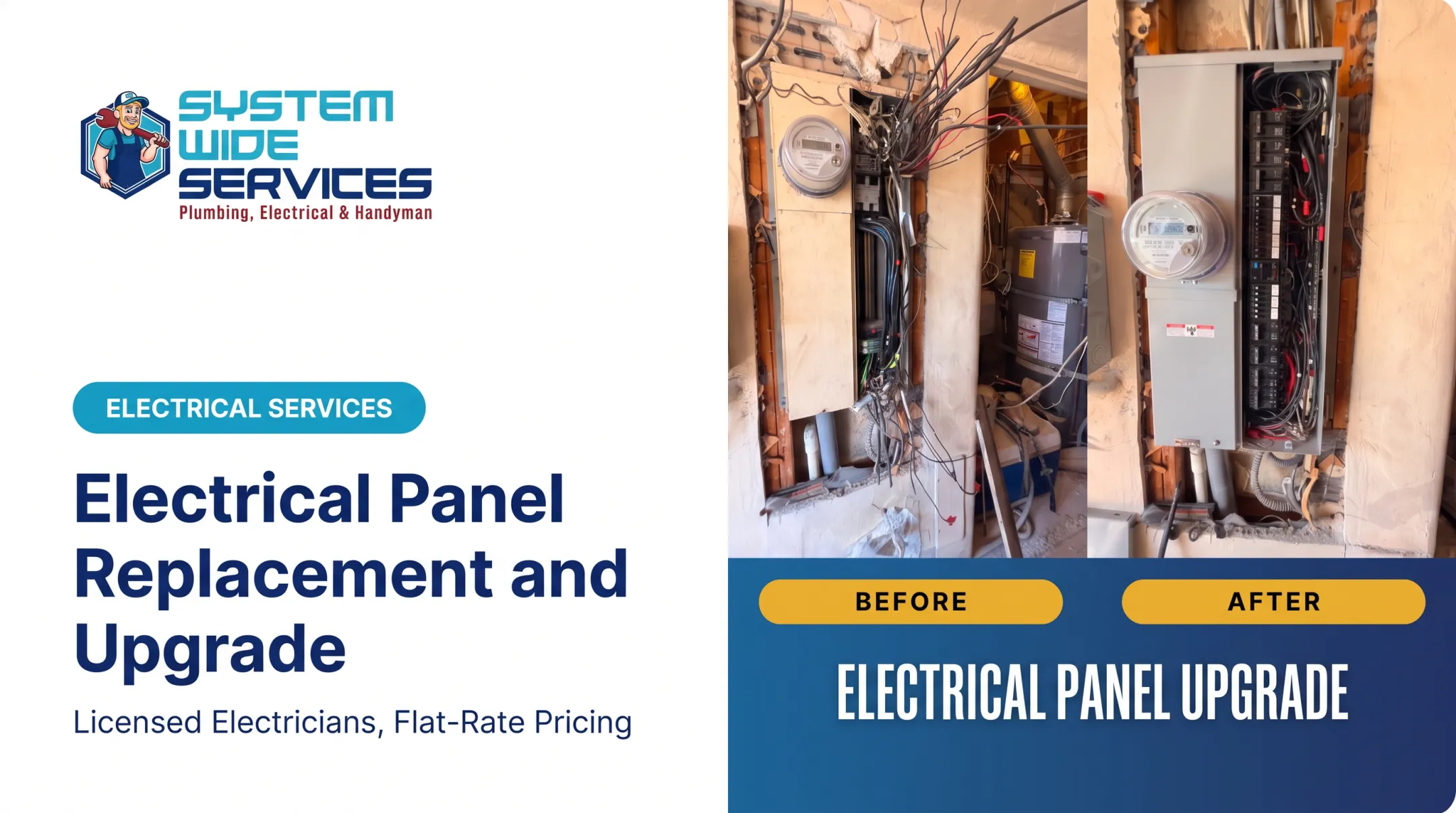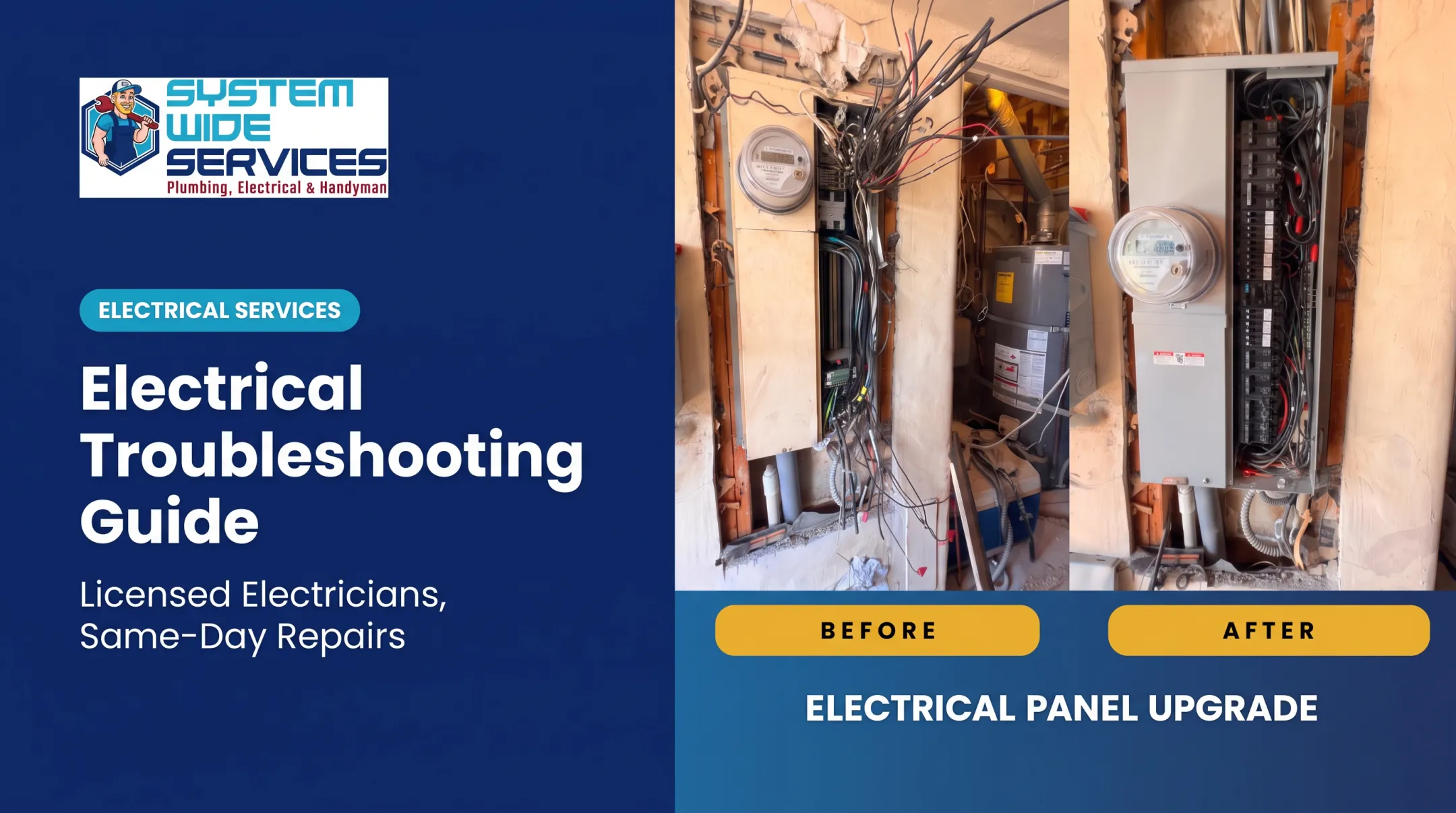

Homeowners usually come to this topic for one of a few reasons: breakers that keep tripping, flickering lights, a safety scare, an EV charger or heat pump on the way, confusion over 100-amp versus 200-amp service, or the price. Electrical failures or malfunctions are a factor in an average of 46,652 home structure fires a year, according to NFPA data.
This guide covers when an upgrade makes sense, what alternatives exist, and what a licensed electrician will do.
Key Takeaways
- Age or amperage alone doesn't decide an upgrade; condition, spare spaces, service capacity, and calculated load do.
- Burning odors, scorch marks, buzzing, corrosion, or shocks need prompt professional attention.
- Cost swings widely with scope: panel only, full service upgrade, meter work, permits, or access.
- A licensed electrician should decide between upgrade, replacement, subpanel, or load management.
Electrical Panel Basics: What an Upgrade Actually Changes
What an electrical panel does
Power enters through the service equipment and splits into branch circuits. Each breaker protects its circuit's wiring from overloads and faults.
Terms you'll hear:
- Main panel, breaker box, service panel: the same thing in everyday use, containing the main breaker and branch breakers
- Subpanel: an additional panel that adds breaker spaces, fed from the main panel
- Service entrance: the incoming conductors and disconnect from the utility
Amperage, service capacity, and circuit space
These are separate things:
- Panel amperage: the panel's rating
- Service capacity: what the utility connection and conductors can deliver
- Breaker spaces: physical slots for breakers
- Load: what your home actually draws
A panel can be full yet have capacity to spare, and a panel with empty slots can still be overloaded. A bigger panel also doesn't automatically increase utility service or let every existing circuit carry more.
LBNL's service sizing brief recommends checking main capacity and open spaces before adding loads.
Upgrade, replacement, rewiring, and alternatives
| Option | What it is |
|---|---|
| Same-amperage replacement | New panel, same rating |
| Service upgrade | Higher rating, often with new conductors or meter work |
| Subpanel | Extra spaces without replacing the main |
| Whole-house rewiring | New branch wiring throughout |
| Load management | Smart devices that limit simultaneous draw |
These aren't interchangeable. The inspection, load calculation, equipment condition, code, and your goals decide which fits.

Signs You Need an Electrical Panel Upgrade
Safety warning signs
Call a licensed electrician promptly for any of these:
- Burning smells, buzzing, or crackling
- Scorch marks, melted parts, rust, or corrosion
- Shocks from fixtures or the panel
- Breakers that look damaged, feel hot, or won't reset
Don't remove the panel cover or attempt repairs. If there's active smoke, fire, or immediate danger, call 911. If it's safe, switch off power to the affected area and call for help.
Performance symptoms
These symptoms can point to overloaded circuits, loose connections, faulty breakers, or wiring defects:
- Frequent breaker trips
- Dimming or flickering lights
- Warm outlets or switch plates
- Intermittent power loss
They don't prove you need a new panel. Only diagnosis tells you which.
Age and outdated equipment
An old panel deserves an inspection even if it seems fine, especially with corrosion, obsolete parts, or no room for needed circuits. Age isn't a deadline: InterNACHI lists service panels at about 60 years, while molded-case breakers may last roughly 30 under good conditions.
Brand worries are often overstated. CPSC closed its Federal Pacific Stab-Lok investigation in 1983 without a recall. Square D recalled specific QO load-center models, not every panel. Challenger's program covered certain GFCI breakers. Check your exact model.
New loads and renovations
These additions often need dedicated circuits or more panel capacity:
- EV chargers, heat pumps, and electric ranges
- Hot tubs, solar, batteries, and generators
- ADUs and major renovations
No single threshold fits every home, so a whole-home load calculation beats assuming everything needs 200 amps.
When repair beats upgrade
The cause may be one worn breaker, a loose termination, a damaged conductor, or an overloaded branch circuit. A good inspection can save you from buying a larger panel when a targeted, code-compliant repair solves it.
For an outdated or recalled panel, System Wide Services can often install a compatible breaker replacement instead of a full upgrade when code allows.
Electrical Panel Upgrade Cost: What Affects the Final Price?
Current cost framework
No honest universal price exists. Scope varies too much.
Angi's 2026 data reports $518 to $2,193 for panel replacement, up to about $4,500 with relocation or an amperage upgrade. A national-lab study estimates service-entrance and panel work at $2,500 to $20,000+ across a broad range of homes.

Neither figure is a quote. California pricing varies widely by scope and utility requirements, so get written estimates from a licensed electrician.
What goes into the price
- Panel and breakers
- Electrician labor
- Permits and inspections
- Load calculation
- Grounding and bonding
- Service-entrance conductors and meter equipment
- Utility coordination
- Trenching or difficult access
- Drywall repair and disposal
A basic swap may include only the first few. A service upgrade can pull in nearly all of them. Relocating a panel runs about $1,500 to $3,500 per Angi.
Comparing project types
- Same-amperage replacement: simplest, for a damaged or obsolete panel
- 100-to-200-amp upgrade: involves service conductors, meter, and utility work
- Subpanel: adds spaces cheaply when the main has spare capacity
- Smart panel or load management: may avoid a service upgrade in some homes
- Rewiring: a separate project driven by wiring condition
The 80% rule
The 80% rule applies to standard overcurrent devices feeding continuous loads (running three hours or more). The continuous load shouldn't exceed 80% of the breaker rating.
It is not a blanket cap on a panel or service. Calculated demand under NEC Article 220 is a separate question. Rely on an electrician working from the current code edition; California's 2025 code is based on the 2023 NEC.

Evaluating a quote
Ask:
- Is this a panel swap or a full service upgrade?
- Does it include permits, utility coordination, grounding, breakers, labeling, testing, and inspection?
- Were future loads identified and assumptions documented?
- What repairs are excluded?
Incentives change fast, so verify them before you rely on a rebate:
- Federal 25C panel credit: ended for property placed in service after December 31, 2025
- California HEEHRA (single-family): reservations fully reserved as of August 2026
- SCE Charge Ready Home: may offer up to $4,200 to eligible customers
Confirm eligibility first.
What Happens During a Professional Electrical Panel Upgrade?
Inspection and load calculation
The electrician reviews:
- Panel condition and service rating
- Meter, conductors, and grounding
- Circuit condition, open spaces, and planned additions
A documented load calculation shows whether a larger panel, new conductors, or an alternative fits.
Permits and utility coordination
Panel and service work typically needs permits, inspection, and often utility coordination, especially when the service or meter changes. Rules and scheduling vary by city and utility. System Wide Services handles permits and utility coordination across Long Beach, LA County, and Orange County.
Shutoff and removal
The electrician shuts off power, identifies and labels each circuit, then removes the old panel and breakers. To prepare:
- Plan for hours without power
- Protect sensitive electronics
- Keep the work area clear
- Arrange alternatives if you work from home or run a business
Installation and reconnection
The electrician mounts the new panel, installs correctly rated breakers, reconnects and labels circuits, and checks grounding and bonding. Protective devices vary with the system and code. Surge protection is generally required for replaced dwelling service equipment, but AFCI and GFCI requirements depend on the circuit and adopted code.
Inspection, testing, and handoff
Expect final inspection where required, utility reconnection if applicable, circuit testing, labeling, and cleanup. Keep these records for insurance and resale:
- Permit and inspection record
- Load calculation
- Equipment details, warranties, and photos Most residential panel swaps take about a day, though permits, inspection, and utility steps can stretch the overall timeline.

Alternatives, Safety, and Choosing an Electrician
Can you avoid a full upgrade?
Sometimes. A DOE/NREL presentation found about 44% of U.S. homes have two or fewer open breaker slots, and describes load management as one way to use existing capacity. Options include:
- Load balancing across circuits
- Efficient or lower-power appliances
- A subpanel
- A smart panel or managed EV charging
None is a universal substitute. A Level 2 charger can go in without an upgrade if capacity and loads allow, but that takes a load calculation and inspection.

Why panel work isn't DIY
- Shock, arc flash, and fire risk
- Wrong breaker sizing
- Damage to concealed wiring
- Failed inspections and insurance complications
- Utility-side hazards
Don't open the cover, move breakers, or touch service equipment. California's owner-builder exemption covers contractor licensing, not permits or inspections.
What to look for in a professional
- An active license in the C-10 electrical classification, checked on CSLB's license lookup
- Insurance and a current bond
- A written contract (required over $500 in California) naming who pulls permits and the completion date
- A written scope and warranty
- A clear approach to load calculations and code compliance
System Wide Services is licensed and insured, holding California CSLB license #1108115 (C-10 electrical). Homeowners in Long Beach and across Los Angeles and Orange County can request an assessment or quote, with upfront pricing approved before work begins.
Frequently Asked Questions
How much does it cost to upgrade an electrical panel?
It depends on the panel, service rating, labor, permits, utility work, wiring, access, and local conditions. Get a written quote based on a site inspection.
Can I upgrade my electrical panel from 100 to 200 amps?
Often, but the electrician must verify service conductors, meter, utility capacity, grounding, panel location, permits, and calculated load first.
Can I upgrade my electrical panel without rewiring my house?
Usually. Compliant existing branch wiring can often stay, but damaged, undersized, or unsafe wiring may need repair or replacement.
How do I know if my electrical panel needs to be upgraded?
Warning signs include repeated trips, flickering lights, overheating, visible damage, no free spaces, an outdated panel, or major new equipment. Only an inspection and load calculation confirm the fix.
Should a 50-year-old electrical panel be replaced?
Not automatically. Have it evaluated for deterioration, obsolete parts, code concerns, and capacity, then weigh repair against replacement.
What is the 80% rule for electrical panels?
Continuous loads shouldn't exceed 80% of a standard breaker's rating. It isn't a cap on the panel itself. Ask an electrician familiar with the current NEC and local rules.