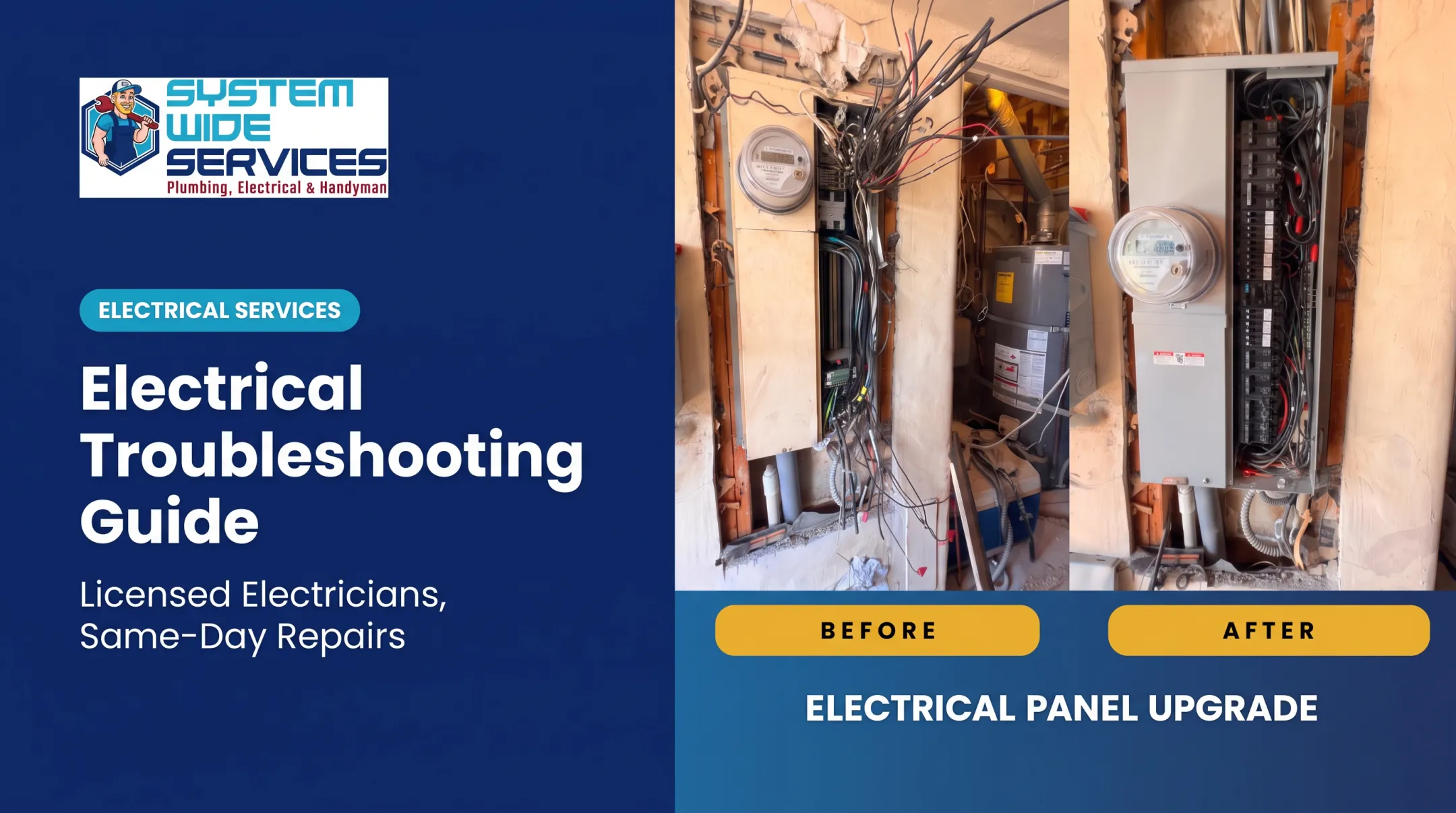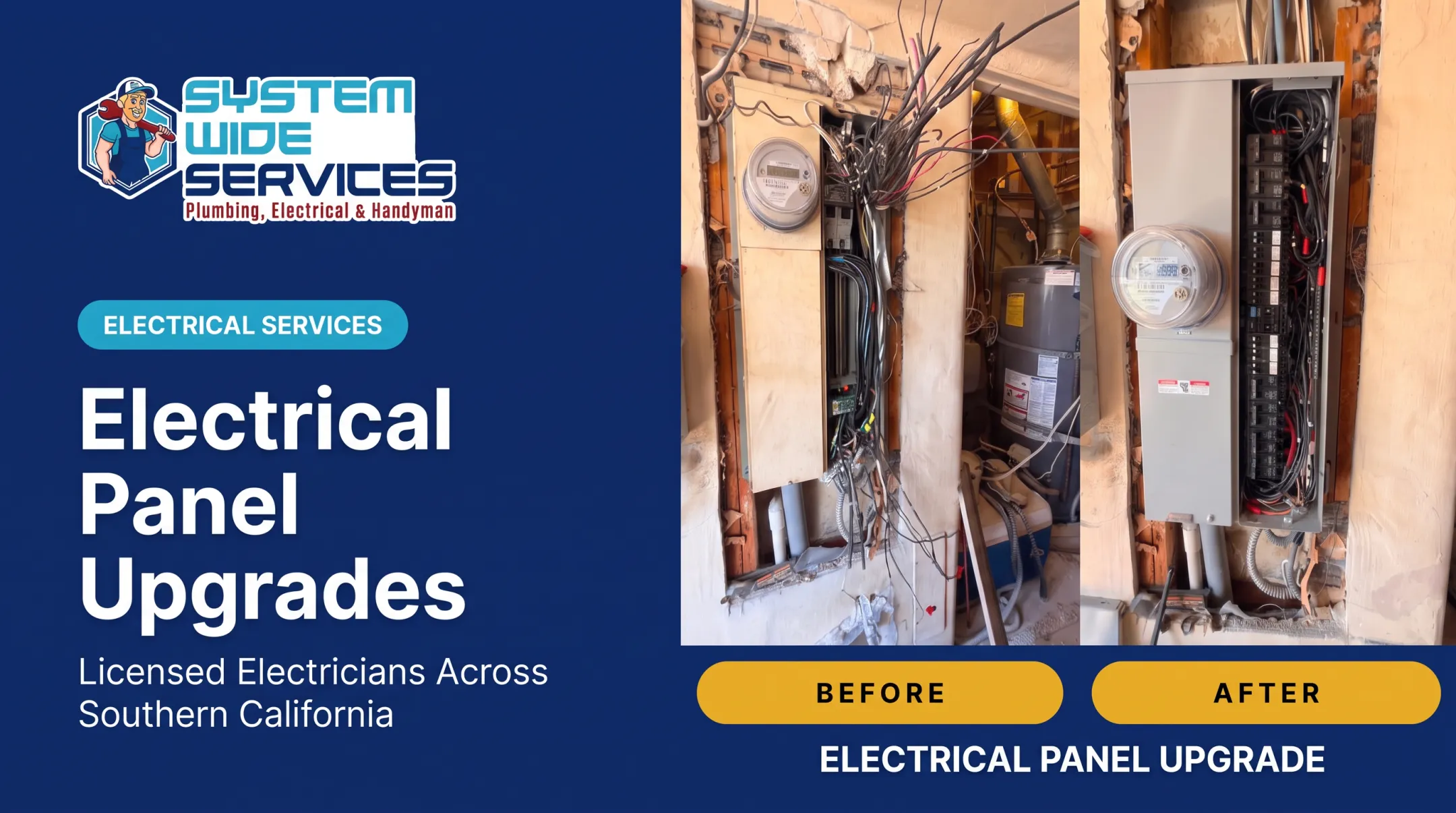

Introduction
Your electrical panel is where power enters the house and splits into circuits. Replacing it and upgrading it are related but different projects, and mixing them up leads to bad quotes.
Most homeowners face this decision for one of a few reasons: a burning smell, breakers that keep tripping, a planned EV charger or heat pump, or a price that doesn't make sense.
Electrical distribution and lighting equipment was the leading cause of home-fire property damage, averaging 31,650 fires a year across 2019-2023. That figure covers wiring, outlets, cords and lighting, not panels alone.
This guide covers when to repair, replace, upgrade, or add a subpanel, what drives cost, how the work unfolds, and how to pick a licensed contractor.
Key Takeaways
- Use a load calculation to choose a same-amp replacement or a capacity upgrade.
- Burning odors, smoke, scorch marks, buzzing, arcing, or repeated trips need prompt professional attention.
- Price depends on service size, meter equipment, wiring, access, permits, and utility work.
- Confirm permit, utility, rebate, and tax-credit rules with current official sources.
Electrical Panel Replacement vs. Upgrade: What Is the Difference?
The parts involved
A residential system includes the main panel, the main breaker (service disconnect), branch circuit breakers, service conductors, meter equipment, and grounding and bonding. Each is a separate scope item on an estimate and a permit.
Replacement, upgrade, or subpanel
- Replacement: remove the old panel and install a new one, often at the same capacity.
- Upgrade: raise service capacity, for example from 100 to 200 amps, and often new service conductors, meter equipment, or utility-side work.
- Subpanel: add breaker spaces downstream of the existing service without increasing total capacity.
CalNEXT reports that capacity-increasing upgrades typically require utility service upgrades.
Why a load calculation comes first
A licensed electrician should calculate your load before recommending a size. This matters most if you plan an EV charger, heat pump, induction range, solar, battery storage, generator, ADU, or major remodel.
Don't assume every 100-amp panel needs 200 amps. Automatic EV load management or a same-amperage replacement can be the right fit. Neither solar, EV, heat pump, nor ADU plans automatically require a 200-amp service. A project-specific calculation and utility review settle it.

When a Panel Replacement May Be Enough
Replacement alone fits when service capacity is adequate but the equipment is not. Typical cases:
- Corrosion or physical damage
- Obsolete panels that can't accept compatible breakers
- Overcrowding with no usable spaces
- Recalled equipment
Recalls are specific. In 2022, Schneider Electric recalled about 1.4 million Square D QO Plug-On-Neutral load centers made February 2020 through January 2022. That was not a brand-wide recall.
Federal Pacific Stab-Lok breakers were never recalled by the CPSC either, though the agency advises investigating why any breaker trips.
Before confirming a replacement-only scope, the electrician should check:
- Connected wiring
- Grounding
- Bonding
- Breaker compatibility
- Condition of the meter equipment
When a Service Upgrade May Be Necessary
An upgrade becomes the right call when:
- Total load exceeds what the service can carry
- No usable circuit spaces remain
- You're adding EV charging, heat pumps, or an electric range
Upgrades often reach beyond the panel. That work can include a new main breaker, meter base, service conductors, grounding components, utility coordination, and inspection.
A 60- or 100-amp service may not safely support today's loads. A full panel with double-tapped breakers is a common trigger for the upgrade.
Signs You May Need Electrical Panel Replacement or Upgrade
Warning signs
- Breakers that trip repeatedly or won't reset
- Flickering or dimming lights
- Buzzing or crackling from the panel
- Warm panel cover
- Corrosion, scorch marks, or melted parts
- Burning odors or smoke
ESFI lists flickering lights and burning smells among warning signs that call for a qualified electrician.
Safety first
Do not open the panel or work inside it. Keep people away from visibly damaged equipment.
If you see smoke, fire, arcing, or severe heat, call emergency services and a qualified electrician. A burning smell near a panel is an emergency. System Wide Services offers same-day electrical repair for these calls.
Don't just reset a tripping breaker. Find out why it tripped.
Age and history
These conditions can justify an inspection:
- An old fuse box
- A problematic panel brand
- Too few breaker spaces
- Past unpermitted work
Age alone doesn't prove replacement is needed.
Capacity and Home-Improvement Warning Signs
Get the panel evaluated before adding major electrical loads such as:
- EV charger
- Heat pump or electric water heater
- Induction range
- Solar or battery system
- Standby generator
- Workshop tools or an ADU
A Level 2 charger needs a dedicated 240-volt circuit and enough panel capacity. Not every charger install forces an upgrade; it depends on existing loads.
Tell the electrician about current equipment and future plans. Sizing for a charger you'll buy next year costs less than reopening the wall later.
How Much Does Electrical Panel Replacement and Upgrade Cost?
No honest universal price exists. Accurate pricing needs an on-site inspection. Reliable, current California installed-price ranges are hard to find, so be wary of any article quoting precise figures.
One dated reference point: CalNEXT cites an SCE estimate of $4,530 in 2019 for a panel replacement, covering only the new panel, conduit, wiring, and breakers. It excluded trenching and associated upgrades. Treat it as history, not a quote.
What drives the price
- Panel and breakers
- Electrician labor
- Permit and inspection fees
- Meter base or service-mast work
- New service conductors
- Grounding and bonding corrections
- Circuit rewiring and wall repair
- Underground trenching, transformer capacity, and difficult access

Permit fees are published locally. Long Beach's schedule effective October 1, 2026 lists a $104 electrical permit minimum, $24 per service up to 200 A, $18 per panel, and a $216 plan-review minimum. These are line items, not totals.
Basic replacement vs. service upgrade
| Scope item | Same-amperage replacement | Higher-capacity upgrade |
|---|---|---|
| New panel and breakers | Yes | Yes |
| Permit and inspection | Yes | Yes |
| Service conductors | Usually existing | Often new |
| Meter equipment | Usually existing | Often changed |
| Utility coordination | Disconnect/reconnect | Often more involved |
Quote checklist
Ask for written line items covering:
- Equipment
- Labor
- Permits
- Utility work
- Code corrections
- Disposal
- Testing and inspection
- Warranty
- Excluded work
Why a 200-Amp Upgrade May or May Not Be Right
Two hundred amps is common in modern homes, but not automatically right for every property. A documented load calculation and the utility's available service determine whether you need that capacity.
When you see a 200-amp price, ask whether it covers only the panel or also meter equipment, service conductors, utility work, permits, and inspection.
Factors that can expand the job include:
- Underground service and trenching
- Long conductor runs
- An undersized utility connection
- Tight panel access
- Older wiring
Ways to Control Project Costs
Bundling the upgrade with an EV charger, remodel, ADU, solar, or HVAC work can cut duplicate labor costs. Confirm the electrical design and permit scope before work begins.
When a full service upgrade is not required, these alternatives can also hold costs down:
- A subpanel for lack of breaker spaces
- A load-management device
- Circuit reconfiguration
- Same-capacity panel replacement
What Happens During an Electrical Panel Replacement or Upgrade?
The typical sequence:
- Consultation and inspection of the current panel
- Review of current and planned loads, then a load calculation
- Written proposal
- Permit application and utility coordination if required
- Installation and testing
- Inspection and homeowner walkthrough

On the day, the electrician documents the circuit layout, confirms the service is safely disconnected, protects the work area, and flags wiring or grounding problems before reconnecting.
Installation covers:
- Mounting the panel and connecting service conductors
- Bonding and separating neutral and ground correctly
- Fitting properly rated breakers
- Labeling circuits and testing each one
Expect a planned outage. Duration depends on scope, so be skeptical of fixed promises.
System Wide Services says most residential upgrades finish in one day, with power off for several hours, though permitting and inspection can extend the overall timeline. Utility work is separate: SCE lists main-panel-upgrade work under its control at an average of 30 business days, up to 45.
The finish includes:
- Permit closure and a circuit-label review
- Breaker checks and documentation
- Warranty information and tips for spotting future problems
Permits, Inspections, and Utility Coordination
Do you need a permit to upgrade a panel in California? Local rules vary by city. La Habra's January 2026 handout, for example, requires a permit before main-panel replacement or upgrade. Check your own city or county building department.
Three separate steps:
- Electrical permit: issued by the building department, normally pulled by the contractor
- Utility disconnect/reconnect: scheduled with the utility, often arranged by the contractor
- Final inspection: done by the local inspector to close the permit

Skipping permits or hiring unlicensed labor creates safety risks and can cause trouble at resale, inspection, and claim time. Confirm your insurer's terms separately.
What to Expect on Installation Day
Prepare by:
- Clearing access to the panel
- Planning for sensitive electronics
- Arranging temporary alternatives if needed
- Telling the contractor about medical equipment
Don't remove the cover, move conductors, reset damaged breakers, or attempt any service work yourself.
After Installation
The electrician should:
- Test circuits
- Verify breaker ratings
- Confirm labels
- Check for abnormal heat or noise
The project isn't done until the required inspection passes.
How to Choose an Electrical Contractor for Panel Work
Before you hire for panel replacement or upgrade work, confirm licensing and get clear answers on scope.
Check the CSLB license lookup for:
- Active license in a C-10 electrical classification
- The $25,000 contractor bond
- Workers' compensation coverage
Also confirm directly with the contractor:
- Panel-upgrade experience and permit practices
- A written estimate and warranty
- Ability to explain the load calculation
CSLB requires a written contract for projects over $500, caps the down payment at the lesser of 10% or $1,000, and recommends three written bids.
Ask these questions:
- Is this a replacement or service upgrade?
- What equipment is included?
- Is a utility disconnect needed?
- Which permits and inspections are included?
- What could change the price?
- What work is excluded?
System Wide Services is a California-licensed C10 electrical contractor operating under CSLB license #1108115. Homeowners get upfront flat-rate pricing approved before work begins, licensed, insured, and background-checked technicians, code-compliant work, and a 100% Service Guarantee. The team serves communities across Los Angeles and Orange counties, including Cerritos, Long Beach, Torrance, Fullerton, and Irvine.
Comparing Estimates
The lowest bid may leave out permits, utility work, grounding corrections, compatible breakers, circuit repairs, inspection, or wall restoration.
Compare these points, not the headline number:
- Scope of work and equipment specs
- Licensing and schedule
- Warranty terms
- Stated exclusions
Frequently Asked Questions
How much does it cost to replace an electrical panel?
It varies with panel type, amperage, labor, access, permits, wiring, and utility work. Get an on-site inspection and a written, itemized quote rather than relying on a single average.
How much does it cost to upgrade an electrical panel to 200 amp in California?
A panel-only swap costs less than a full service upgrade with meter equipment, conductors, and utility work. Ask what each quote includes and compare itemized local bids, since a single statewide average is hard to pin down.
Do I need a permit to upgrade my electrical panel in California?
Generally yes. Confirm with your local building department. A licensed contractor can typically manage the permit and inspection.
Are there any rebates or tax credits in California for electrical panel upgrades?
The federal 25C credit ended for property placed in service after December 31, 2025, and HEEHRA single-family funds were fully reserved. SCE's Charge Ready Home offers panel-upgrade rebates of up to $4,200 for eligible EV-charging customers; check current funding.
How long does an electrical panel replacement take?
The physical installation is often a day, with power off for several hours. The full timeline can also include permitting, utility scheduling, inspection, rewiring, and corrective work.
Can I add a subpanel instead of replacing my main electrical panel?
A subpanel fixes a shortage of breaker spaces but not inadequate total capacity. Get a load calculation before choosing.