
Homeowners: Check EV Charger Panel Capacity Before Paying for Upgrades
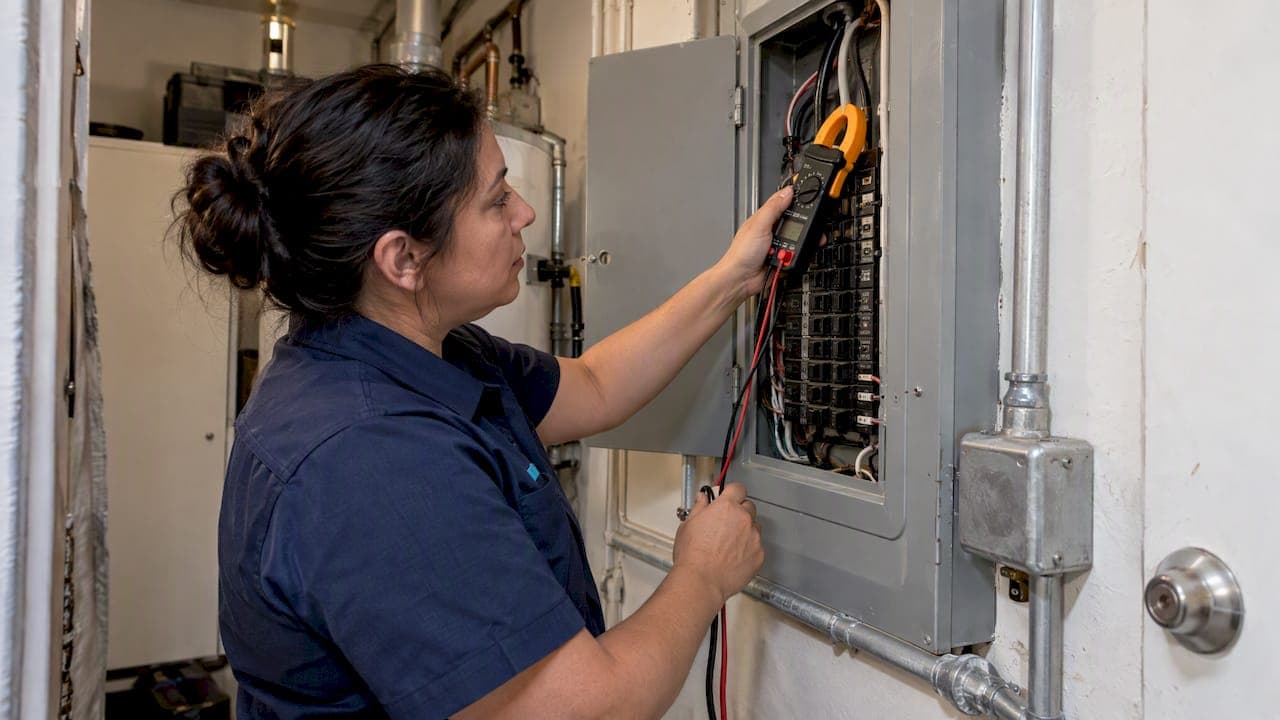
Maybe. Many 200A panels can handle a Level 2 charger, while a 100A panel often needs a formal load calculation or a smarter charging setup. The one next step is the same either way: have a licensed electrician run that calculation. Free breaker slots alone prove nothing, and the National Electrical Code (NEC) treats charging as a continuous load that must be sized with extra margin.
TL;DR:
- Before the visit, gather the main breaker rating, empty slots, major appliance loads, and clear photos of the panel label and meter.
- The NEC requires charger circuits to be sized at 125% of continuous output, so an electrician compares full charger demand with calculated service capacity.
- Most home Level 2 chargers draw up to 30 amps on a dedicated 40 amp circuit; adjustable settings or vehicle limits may allow less.
- Level 2 installation costs range from $1,000 to $7,000 before incentives, while panel work can add expense and utility service upgrades may take months.
- When calculations are tight, load management may avoid an upgrade, but charging can slow during busy periods and constrain plans for a second vehicle.
Table of Contents
- How can you tell if your panel is near its limit?
- What does a formal load calculation actually involve?
- What do Level 2 chargers actually require?
- What happens if your panel needs an upgrade?
- Can you skip the upgrade with smarter charging?
- What should you bring to your electrician?
- Why a pro assessment beats guessing
- Let us check your panel and install your charger
- FAQ
- Sources
How can you tell if your panel is near its limit?
Before anyone visits, you can gather most of what an electrician needs. Open the panel door and look at the main breaker at the top. The number printed on it is your service rating. Then count the open slots and write down your big electric loads.
- Note the main breaker amperage and how many breaker slots sit empty.
- List major loads: central air conditioning, electric range, electric dryer, electric water heater, and any existing EV-ready circuits.
- Watch for warning signs: breakers that trip often, a warm panel cover, a burning smell, or an older panel brand with a recall history.
- Photograph the panel label, the open panel and your meter.
Pro Tip: Take the panel photos in daylight with the door fully open and the label readable. A clear image often saves a second trip.
Our guide to signs your home wiring is outdated covers the older-panel red flags in more detail.
What does a formal load calculation actually involve?
“Adequate capacity” is not a fixed number. It is the result of a calculation, and a licensed electrician performs it by working through a short list of inputs.
- Confirm the main service rating.
- Record the nameplate ratings of large appliances like the range, dryer, water heater and air conditioner.
- Identify which loads run continuously.
- Apply the demand and diversity factors the code allows, since not everything runs at once.
- Add the proposed charger at its full rating and compare the total to the service.
The EV charger is the tricky input. The U.S. Department of Energy’s guide notes that the NEC requires wiring and overcurrent protection for chargers to be sized at 125 percent of the charger’s continuous output rating.
Here is an illustrative walk-through with made-up numbers. Say a home’s calculated demand is already close to its service limit once the range, dryer and air conditioner are counted. Adding a charger could leave little or no cushion, so the electrician would likely recommend a different approach.
When the math comes up short, the next steps can include load management, a subpanel, a panel replacement, or a utility service upgrade. We cover each of those below.
What do Level 2 chargers actually require?
Level 2 equipment runs on 240 volts, and the numbers below are what you compare against your calculation. According to the Alternative Fuels Data Center, Level 2 equipment can operate at 40 to 80 amperes, and most residential units operate at up to 30 amps, delivering 7.2 kW on a dedicated 40-amp circuit.
- A dedicated 40-amp circuit can serve a residential Level 2 charger operating at up to 30 amps.
- Circuit needs vary with the charger and vehicle.
- NREL describes dedicated branch circuits of 20 to 80 A depending on the equipment.
- Higher-output units are also available.
Level 2 charging can add about 10 to 20 miles of range per hour.
For context, that means an overnight session can recover most of a typical day’s driving. Adjustable chargers and a vehicle’s own onboard charging limit are practical exceptions: a unit set below its maximum, or a car that cannot accept the full rate, may fit a smaller circuit.

What happens if your panel needs an upgrade?
Upgrades range from simple to substantial. The easiest case is adding one breaker to a panel with real spare capacity. The middle path is a subpanel that extends your existing service. A full panel replacement swaps the box itself, and a utility service upgrade increases the power coming to the house.
Several things drive the cost:
- Meter work and utility coordination
- Trenching and conduit runs, especially for a detached garage
- Permit fees and inspection
- Permit turnaround times in your city
The Department of Energy cautions that panel and infrastructure work can add significant cost and that utility service upgrades may take months. NREL puts Level 2 installation costs roughly $1,000 to $7,000 before incentives, depending on the upgrades needed.
The timeline usually runs from assessment to quote, then permit, then installation and inspection. Delays most often come from utility scheduling and permit review. Permit expectations vary by city, and Capitalprolighting shows how the process generally works for permanent electrical installs. Ask for a written estimate and confirm it includes permits and any utility coordination. You can read what a panel project involves on our electrical panel upgrade page.
Can you skip the upgrade with smarter charging?
Sometimes. If your calculation comes up tight, there are lower-cost routes worth raising with your electrician before committing to a service upgrade.
- Automated load management (ALMS): the system watches household demand and throttles the charger when other big loads run, which keeps total draw under the main breaker.
- Adjustable or derated chargers: setting a unit to a lower amperage lets it fit on a smaller circuit.
- Smart panels and energy management hardware: these can limit charging automatically as part of whole-home demand control.
- Circuit sharing: one circuit serving two big loads, such as a dryer and a charger, with a controller deciding which runs.
The Department of Energy notes that ALMS and power-sharing strategies can allow charging in constrained scenarios. The trade-offs are real: slower charging when your home is busy, less room to add a second vehicle later, and monthly fees on some ALMS services.
Pro Tip: Ask whether the charger you are considering supports load management natively. Retrofitting that feature later usually costs more.
What should you bring to your electrician?
A prepared homeowner gets a faster and more accurate quote. Work through these before the visit.
- Gather your photos: panel label, open panel, meter, and the main breaker rating.
- Write down the number of open slots and any appliance nameplate ratings you can read.
- Note when the household typically runs several big loads at once, such as evening cooking plus laundry.
- Ask the electrician whether they will perform a load calculation, whether a permit is needed, and whether a service upgrade looks likely.
- Ask for an expected cost range and timeline, and whether they handle EV charger installation themselves.
A solid quote spells out the scope, parts, labor, permits, utility coordination and any warranty. If one of those is missing, ask before signing.
Why a pro assessment beats guessing
Open breaker slots are not proof of electrical capacity. We see homeowners buy a charger first and learn afterward that their service was already close to its limit, and that is the expensive order of operations. A licensed electrician’s calculation can help avoid a wrong purchase.
If a kitchen remodel, a new roof or other work is already planned, that is the cheapest moment to run conduit or prepare the panel for later. AFDC building code guidance notes that planning for future capacity reduces retrofit costs.
— Van Castaneda
Let us check your panel and install your charger
Our licensed electricians handle the whole job from first look to finished install: electrical inspection, panel upgrades and EV charger installation. As a veteran and woman-owned team serving Cerritos, Long Beach and surrounding areas of Los Angeles and Orange County, we keep everything under one roof so you are not juggling contractors.
Here is what a visit with us covers:
- A look at your panel, meter and major loads
- A clear answer on whether your service can carry the charger
- Options if it cannot, including load management or an upgrade
- A written estimate with upfront pricing
Current pricing details are on our website, and we explain what is included before any work starts. Browse our electrical services or read how our EV charger installation works, then call us to book your assessment.
FAQ
How many amp EV charger do most homes need?
Most residential Level 2 chargers operate at up to 30 amps and are served by a dedicated 40-amp circuit, according to the Alternative Fuels Data Center. Circuit needs vary by model and vehicle. Your electrician matches the charger to your calculated capacity.
Can you install a Level 2 charger on a 100 amp service?
Often yes, but only after a load calculation confirms enough headroom. If the calculation is tight, load management or an adjustable charger can keep total demand under the limit without a service upgrade.
Does a Tesla charger need a 50 or 60 amp breaker?
It depends on the charger setting you choose. Because the NEC requires circuits to be sized at 125 percent of continuous output, the required breaker size depends on the charger’s continuous output. Your electrician sizes it to the unit you install.
Do I need a permit for an EV charger?
In many jurisdictions, yes. The Alternative Fuels Data Center describes permitting as a critical installation step, and a professional assessment before buying equipment helps avoid mismatches. Your electrician can tell you what your city requires.
Sources
- Alternative Fuels Data Center: Charging Electric Vehicles at Home
- Electric Vehicle Charging for Multifamily Housing
Recommended
Need a hand with this? We've got you covered.
System Wide Services handles plumbing, electrical, and handyman work across Long Beach and LA & Orange County.