
EV Charger Circuits for Homeowners: NEC 210.17 Says No Sharing
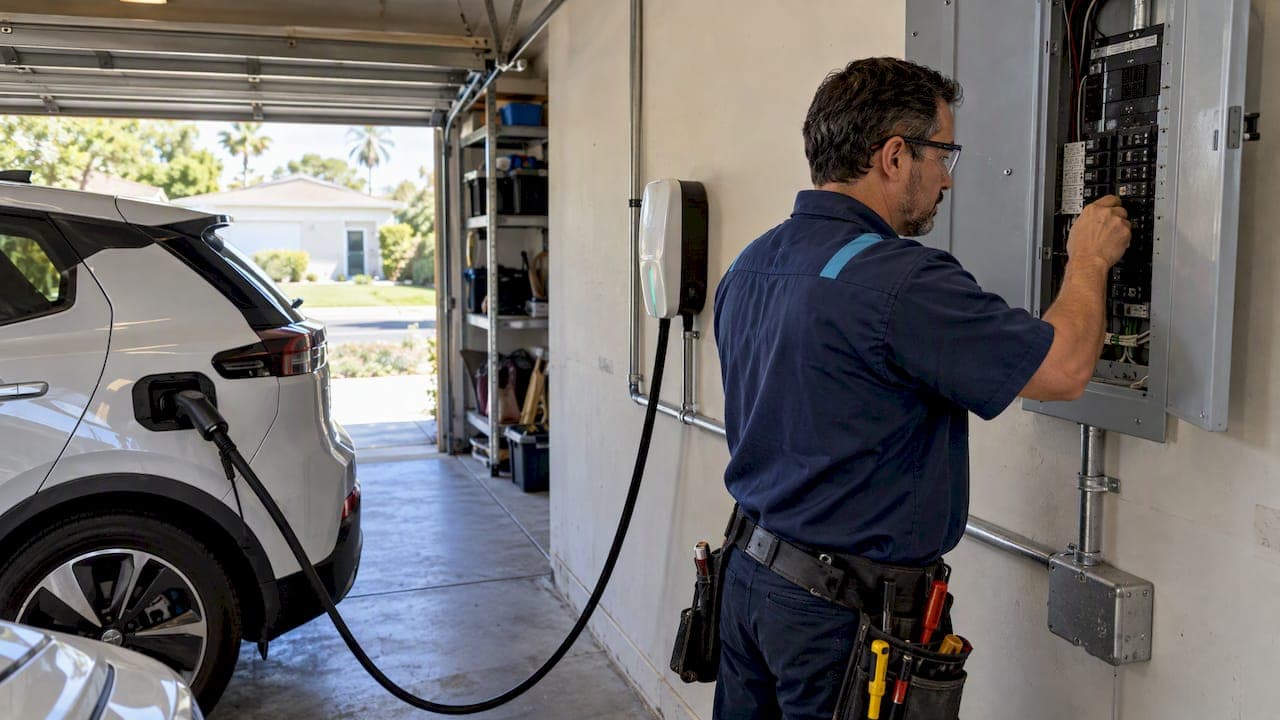
Yes, EV charging equipment generally requires a dedicated branch circuit under the National Electrical Code, specifically NEC Section 210.17 and Article 625. Level 1 charging can sometimes run on a dedicated 120V outlet, but Level 2 charging needs its own 240V circuit sized specifically to your charger’s electrical rating.
TL;DR:
- Level 1 charging adds 3 to 5 miles of range hourly through a 120V outlet; an existing circuit may work, though a dedicated circuit reduces overload risk.
- Because EV charging counts as a continuous load, a 32A charger needs a 40A breaker, while 40A and 48A chargers need 50A and 60A breakers.
- A load calculation must check existing appliances and panel capacity before equipment selection; load management or overnight charging may help avoid a service upgrade.
- Most installations need permits and final inspection, while GFCI interpretations vary by jurisdiction; ask an electrician to coordinate with the local inspector and use listed equipment.
Table of Contents
- What the code says: NEC basics for EV branch circuits
- Level 1 vs Level 2 charging: which outlet fits your setup
- Sizing the breaker and wire: amps, math, and real examples
- Panel capacity, subpanels, and when you need a service upgrade
- Permits, inspection, and the current GFCI conversation
- Cost and timeline: what to expect from quote to final inspection
- How to prepare and hire the right electrician
- Effects of EV dedicated circuits on home energy management and load balancing
- Considerations for future EV charger upgrades or additional vehicles
- Safety considerations beyond GFCI: surge protection and disconnects
- Publisher perspective: our approach to EV charger installs
- How we can help with your EV charger installation
- FAQ
- Sources
What the code says: NEC basics for EV branch circuits
The National Electrical Code is clear on this point. NEC 210.17 states that outlets installed for the purpose of charging electric vehicles must be supplied by a separate branch circuit, and that circuit cannot power anything else in your home. No sharing with the garage lights, no splitting off to a workbench outlet. Your charger gets its own path back to the panel.
Article 625 goes further for equipment rated above 16 amps or 120V, requiring an individual branch circuit for the electric vehicle supply equipment (EVSE). A “dedicated” circuit means exactly one device draws from that breaker. An “individual” branch circuit takes that a step further: nothing else is ever wired into it, now or later.
EV charging also counts as a continuous load, meaning it runs at or near full capacity for three hours or more. We will walk through what EV charging as a continuous load looks like in real numbers shortly.
When you’re vetting an electrician for this work, listen for references to these trust signals:
- NEC compliance: citations to Article 625 and Section 210.17 specifically, not vague mentions of “code.”
- NFPA guidance: awareness of how the National Fire Protection Association’s standards apply to residential EVSE.
- DOE and AFDC recommendations: the Department of Energy’s Alternative Fuels Data Center advises using NRTL-listed equipment and hiring qualified electricians for the work.
An electrician who can speak fluently to all three is working from the right playbook.
Level 1 vs Level 2 charging: which outlet fits your setup
Your charging level determines the outlet type, the circuit voltage, and whether a dedicated circuit is strictly required or simply the smarter choice.
Level 1 charging uses a standard 120V connection, typically a NEMA 5-15 outlet. Because it draws relatively little current, Level 1 sometimes runs on an existing household circuit, though the DOE notes that many owners still benefit from a dedicated 120V circuit to avoid overloading a shared one. Charging speed is slow, often adding only 3 to 5 miles of range per hour, which works fine for plug-in hybrids or light daily driving.
Level 2 charging steps up to 240V and delivers far faster charging, usually in the range of 20 to 40 miles of range per hour depending on the equipment. This is where a dedicated circuit stops being optional. Homeowners typically choose between:
- Hardwired EVSE: permanently wired to the circuit with no plug, often required or preferred for higher-amperage chargers.
- NEMA 14-50 receptacle: a common 50-amp outlet that accepts portable Level 2 EVSE units.
- NEMA 6-50 receptacle: another 240V option, frequently used for similar portable chargers.
Portable 240V EVSE plugged into a receptacle gives you flexibility to take the charger with you or swap units later. Hardwired installations tend to be more permanent and may simplify inspection since there’s no connector to evaluate separately, but either path still requires a dedicated circuit sized to the equipment and a final inspection sign-off.
Sizing the breaker and wire: amps, math, and real examples
This math is not a suggestion. NEC Article 625 treats EV charging as a continuous load, so the math is mandatory.
Here’s how that plays out for a few common scenarios:
- A 32A charger needs a breaker rated for at least 40A (32 x 1.25 = 40). This is one of the most common home charger setups.
- A 40A charger needs a 50A breaker (40 x 1.25 = 50), typically paired with 6 AWG copper wire depending on run length.
- A 48A charger, common on higher-output Level 2 units, needs a 60A breaker (48 x 1.25 = 60).
- A smaller 16A charger, often used for lighter daily charging needs, can run on a 20A breaker.
You’ll see 16A, 20A, 32A, 40A, 50A, and 60A breakers most often in residential EV installs, each paired with wire gauges your electrician selects to match both the amperage and the distance from your panel to the charger location. A longer run may need a heavier gauge wire than the amperage alone would suggest, to prevent voltage drop.
The final word on sizing always comes from the charger’s nameplate rating and your local authority having jurisdiction (AHJ). A manufacturer’s spec sheet and an electrician’s read of your specific code cycle should agree before any wire gets pulled.
Panel capacity, subpanels, and when you need a service upgrade
Before quoting breaker size, a qualified electrician checks two things: how many open slots your panel has, and whether your total service ampacity can handle the additional continuous load. This usually means a load calculation that accounts for your existing appliances, HVAC equipment, and other major draws alongside the new EV circuit.
Several situations commonly trigger a panel or service upgrade:
- An older 100A service that was adequate decades ago but leaves little headroom for a 40 to 60 amp EV circuit on top of everything else.
- A fully populated panel with no open breaker slots, requiring a subpanel or a full panel swap.
- Obsolete or unsafe panel brands and breakers that an inspector flags during the EV assessment, unrelated to the EV load itself but surfaced by the visit.
Utility programs add another wrinkle. Some, like certain municipal utility rebate programs, require a dedicated EV meter or specific metering configuration to qualify for rebates, which can affect how your installation is scoped from the start.
Pro Tip: Ask your electrician for a load calculation before you commit to a charger model. It’s the fastest way to learn whether your existing panel can handle the addition or whether an upgrade is coming either way.
Permits, inspection, and the current GFCI conversation
Most jurisdictions require a permit and a final inspection for EVSE installation, and your electrician should be the one pulling it, not you. This protects you if something needs correcting before the inspector signs off, and it confirms the work meets your local code cycle.
The DOE’s guidance is direct on using only NRTL-listed (nationally recognized testing laboratory) equipment and hiring qualified contractors for the installation itself. Skipping either one puts your warranty and your safety at risk.
There’s also an active conversation in the code world worth knowing about. NFPA and NEC 2026-cycle materials discuss proposed changes to Section 625.54, which governs ground-fault protection for EV receptacles and hardwired equipment. Interpretations currently vary by jurisdiction, which means:
- Your inspector’s read on GFCI requirements may differ from a neighboring city’s.
- A qualified electrician coordinates directly with your local AHJ to avoid a failed inspection.
- Staying current on these GFCI requirements protects your timeline as much as your safety.
Cost and timeline: what to expect from quote to final inspection
Costs vary widely based on your existing panel, the distance from panel to parking spot, and whether you need a hardwired unit or a receptacle. A dedicated 120V circuit addition tends to sit at the lower end of the spectrum. A 240V receptacle installation, such as a NEMA 14-50, runs higher due to the heavier wire and breaker involved. Hardwired Level 2 installations with a short conduit run land in a similar middle range, while anything requiring a panel upgrade, long trenching, or a new subpanel pushes costs noticeably higher.
From quote to final sign-off, most straightforward installs move through:
- Permit processing: typically a few days to a couple of weeks depending on your city.
- Scheduling: coordinating the electrician’s availability once the permit clears.
- On-site work: often completed in a single day for standard installs without panel upgrades.
A few factors reliably drive costs up: meter upgrades, conduit runs longer than a typical garage-to-panel distance, trenching under a driveway or walkway, and any panel work discovered once the electrician opens the box. One useful resource on panel upgrade budgeting breaks down how those variables stack.
How to prepare and hire the right electrician
A little prep work before your first contractor visit saves time and gets you a more accurate quote.
- Photograph your electrical panel, including the open breaker space (or lack of it) and the panel’s age and brand.
- Pick your parking spot so the electrician can estimate wire run length and conduit needs.
- Note your typical daily mileage and check your vehicle’s onboard charger specs, since that determines whether Level 1 is enough or Level 2 makes more sense.
- Gather your charger model, if you’ve already chosen one, so the quote reflects its exact amperage.
When you’re talking to electricians, ask directly about licensing and insurance, specific EV installation experience, who pulls the permit, their estimated breaker and wire size for your situation, expected turnaround, and what warranty covers the work.
Expect an itemized quote, a copy of the permit once filed, and a final inspection sign-off at project close. If a contractor is vague about any of these, or hesitant to pull a permit at all, treat it as a signal to look elsewhere.
Pro Tip: Save your final inspection documentation. It matters for home insurance, resale disclosures, and any future electrical work tied to that circuit.
Effects of EV dedicated circuits on home energy management and load balancing
Adding a 40 to 60 amp continuous load to your home’s electrical system changes how your panel manages demand, even if you never notice it day to day. A dedicated EV circuit draws from your main service alongside your HVAC, water heater, and major appliances, so your electrician’s load calculation exists specifically to confirm your total demand stays within safe limits.
Some homeowners address this with load management devices that automatically reduce or pause EV charging when other high-demand appliances kick on, rather than paying for a full service upgrade. This approach, sometimes built into the EVSE itself, lets a single service handle more total demand without every circuit running at once.

Charging schedules also play a role. Many EV owners set their charger to run overnight, which naturally avoids overlap with daytime cooking, laundry, and HVAC cycles. That timing choice does more for your panel’s real-world headroom than most equipment upgrades. DOE’s multifamily EV charging guidance describes similar load-sharing strategies at a larger scale, using energy management systems so multiple charging ports can share circuit capacity instead of each needing a full dedicated run. The same logic applies, at a smaller scale, to a single home weighing a second charger down the road.
Considerations for future EV charger upgrades or additional vehicles
If a second EV is anywhere in your future, it’s worth raising with your electrician now rather than after the first install is finished. Adding a charger later, especially if your panel is already near capacity, often costs more than planning for both from the start.
A few questions worth asking during your initial site visit:
Will your panel support a second dedicated circuit down the line, or does the current install already use the last available capacity? If a second vehicle is likely within the next few years, a subpanel or slightly larger service now can save a second round of permitting, inspection, and panel work later.
It’s also worth asking whether your chosen charger model supports future firmware or hardware updates for faster charging speeds, since EVSE technology continues to shift toward higher outputs. A circuit sized generously today, within what your panel can safely support, gives you room to upgrade the charger itself without rewiring anything.
For households replacing a gas vehicle with an EV in the next few years, mentioning that timeline to your electrician during the first installation lets them size the panel assessment accordingly instead of treating each charger as an isolated project.
Safety considerations beyond GFCI: surge protection and disconnects
Ground-fault protection gets most of the code attention, but a few other safety elements deserve equal weight in your installation.
Whole-home surge protection is worth discussing when you add a Level 2 charger, since EVSE electronics are sensitive to voltage spikes from grid fluctuations or lightning strikes. A surge protective device installed at your panel adds a layer of protection for the charger and the rest of your home’s electronics.
Proper disconnects matter too, particularly for hardwired installations. Code typically requires a means to disconnect power to the EVSE for service or emergency situations, and your electrician should confirm this is accessible and clearly labeled, not buried behind storage boxes in the garage.
Weatherproofing is another consideration if your charging location is outdoors or in an unconditioned garage exposed to moisture. Equipment rated for the installation environment, correctly sealed conduit, and a disconnect protected from the elements all factor into a safe long-term setup. None of these replace GFCI protection, but they round out an installation that holds up over years of daily use rather than just passing inspection on day one.
Publisher perspective: our approach to EV charger installs
We handle EV charger installation, panel upgrades, and electrical inspections following a consistent sequence on every job: site visit, load calculation, permit pull, installation, and final inspection. That order exists for a reason. Skipping the load calculation to save a week almost always costs more time later.
— Van Castaneda
How we can help with your EV charger installation
If you’re ready to move from research to an actual installation, we handle EV charger installation from the initial load calculation through final inspection sign-off, managing the permit process so you don’t have to chase it down yourself.

A few reasons homeowners choose us for this work:
- A single team handles the electrical assessment, panel work if needed, and the EV circuit itself, so you aren’t coordinating between separate contractors.
- Responsive service when your situation calls for it, with upfront pricing before any work begins.
- Clear communication at every step, from the first site visit to the final walkthrough.
Reach out through our electrical services page for a site assessment, and we’ll walk you through exactly what your home needs.
FAQ
Do you need a dedicated circuit for an EV charger?
Yes, in most cases. NEC Section 210.17 requires outlets installed for EV charging to be on their own branch circuit, and Level 2 charging in particular needs a dedicated 240V circuit sized to the charger.
Can I just plug my EV into a 240V outlet?
Only if that outlet is on a dedicated circuit properly sized for your charger’s amperage, such as a NEMA 14-50 or NEMA 6-50 installed specifically for EV charging. Plugging a Level 2 charger into a shared or undersized 240V outlet risks tripped breakers or overheating, so a licensed electrician should confirm the circuit before you rely on it daily.
What is a dedicated electric circuit?
A dedicated electric circuit runs from your breaker panel to a single outlet or piece of equipment and powers nothing else. For EV charging, this means the circuit feeding your charger cannot also supply any other outlet, light, or appliance in your home.
Do I need a 50 or 60 amp circuit breaker for an EV charger?
A 40A charger typically needs a 50A breaker, while a 48A charger needs a 60A breaker, so the exact size comes from your specific equipment’s nameplate rating.
Sources
- Charging Electric Vehicles at Home | Alternative Fuels Data Center
- Electric Vehicle Charging for Multifamily Housing (DOE)
- NFPA 70 TIA Log No. 1892 (625.54) public documents
- Branch Circuits for EV Charging Equipment Outlets | ECMweb
Recommended
Need a hand with this? We've got you covered.
System Wide Services handles plumbing, electrical, and handyman work across Long Beach and LA & Orange County.