
Homeowners: How to Spot a Federal Pacific Panel and When to Replace It
If your home still has a Federal Pacific Electric (FPE) Stab‑Lok panel, replacing it is the safe default, not an optional upgrade. Independent testing has documented high failure rates in these breakers, and most licensed electricians won’t recommend patching around the problem. Your next move: schedule a licensed electrician inspection and get a written quote. Expect a mid-to-high four-figure cost range, and know that many insurers and lenders will ask for an electrical panel upgrade before they’ll write or renew a policy.
TL;DR:
- Replacing an FPE Stab-Lok panel is necessary because these panels have high failure rates, with failure-to-trip rates around 60%, posing fire risks.
- The cost of replacing an entire panel can range from low thousands for simple upgrades to several thousand dollars for service size or enclosure changes.
- Inspections should be done exclusively by licensed electricians, who will verify panel type, condition, and decide on replacement, not homeowners.
- Homeowners should prioritize full panel replacement or a listed retrofit where permitted, avoiding unreliable breaker-only replacements.
- Insurance and lender requirements often mandate panel replacement before policy issuance or home sale, making proactive upgrades advisable.
Table of Contents
- How to Identify a Federal Pacific (FPE) Stab-Lok Panel
- Why These Panels Are Considered Dangerous: The Evidence
- Signs and Situations That Should Prompt Replacement Now
- How Much Federal Pacific Panel Replacement Costs
- Replacement Options: Full Swap, Retrofit, or Neither
- Permits, Inspections, and What to Expect
- Insurance and Real Estate: What to Expect From Insurers and Lenders
- Choosing a Licensed Electrician for Panel Replacement
- What This Guide Recommends and Why
- Get Your Federal Pacific Panel Inspected and Replaced
- Sources
- FAQ
How to Identify a Federal Pacific (FPE) Stab-Lok Panel
Before anyone touches a screwdriver, you need to know what you’re looking at. Federal Pacific Electric panels were installed heavily in homes built between the 1950s and 1980s, so if your house falls in that window, check the panel in your garage, basement, or utility room first.
Look for these identifiers on the panel cover and breakers:
- The name “Federal Pacific Electric,” “FPE,” or “Stab-Lok” printed on the panel door or interior label
- A distinctive red stripe running across the breaker handles
- Breakers that look unusually thin and packed tightly side by side
- A panel cover with rounded corners and a simple latch, common to that era
InspectAPedia’s identification guide includes photos that make this comparison easier if you’re unsure what you’re seeing.
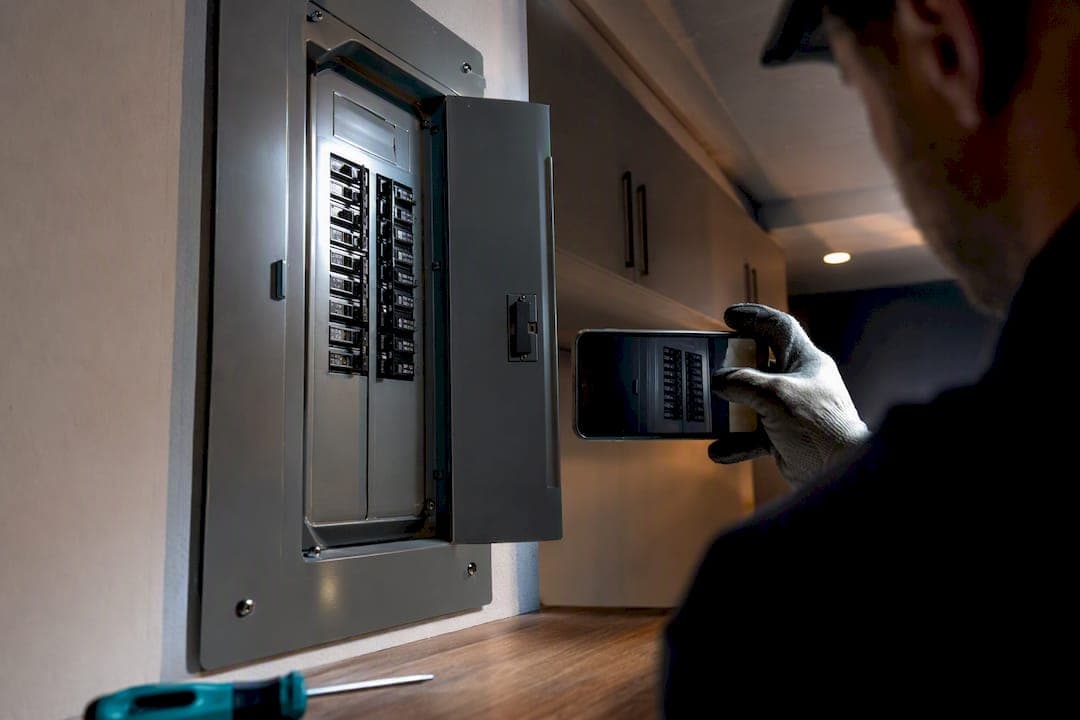
Pro Tip: Take a photo of the panel label with your phone and text it to an electrician before scheduling a visit. Most can confirm whether it’s an FPE Stab-Lok panel from the picture alone, saving you a wasted trip.
One rule matters more than any visual check: never remove the deadfront cover or pull breakers yourself. Interior inspection on a potentially defective panel belongs to a licensed electrician, not a homeowner with a flashlight.
Why These Panels Are Considered Dangerous: The Evidence
The core problem with FPE Stab‑Lok breakers is that they sometimes don’t trip when they’re supposed to. A breaker’s entire job is to cut power during an overload before wires overheat. When it fails silently, the panel becomes a fire risk instead of a safety device.
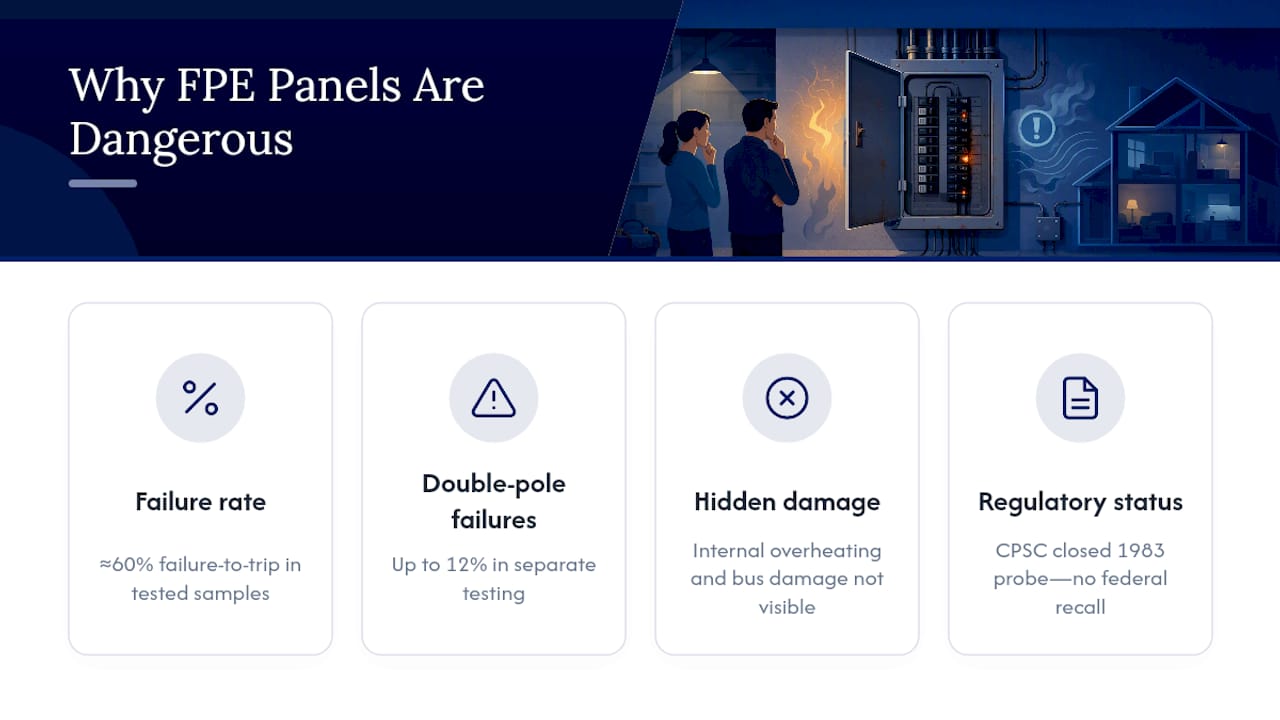
Testing summarized by InspectAPedia found failure-to-trip rates around 60% in certain breaker samples, with double-pole breaker failures reaching as high as 12% in separate testing. Field inspections have also documented internal overheating and bus damage that isn’t visible from outside the closed panel.
That last point matters. A panel can look perfectly normal, with no scorching or smell, and still have a damaged bus bar or a breaker that’s already failed internally.
Here’s where the confusion usually starts: the CPSC closed its investigation into FPE breakers in 1983 without issuing a federal recall. That doesn’t mean the panels were cleared. It means the case closed as a product liability and testing matter rather than a mandated removal, which is why millions of these panels are still legally in homes today even as forensic evidence keeps piling up against them. Replacing individual breakers, including “new-old-stock” FPE replacements sold online, doesn’t fix the underlying bus and design issues that testing has flagged.
Signs and Situations That Should Prompt Replacement Now
Some situations don’t leave room for scheduling flexibility. If you notice any of the following, treat it as urgent:
- A burning smell near the panel, or any visible smoke
- Scorch marks, melted plastic, or discoloration on the panel face or breakers
- Breakers that feel hot to the touch
- A buzzing or crackling sound coming from the panel
- Frequent trips with no clear cause, or breakers that won’t reset properly
Beyond hazard signs, certain life events force the timeline. Selling a home almost always triggers a four-point inspection that flags FPE panels. Insurers frequently require replacement before issuing or renewing a policy, and lenders can hold up escrow until the panel is addressed. A recent electrical fault, even a minor one, is also reason enough to have a professional evaluate the whole system rather than just the breaker that tripped.
A proper inspection should cover the panel’s condition, grounding and bonding, breaker function, and whether the service size still matches your household electrical load.
How Much Federal Pacific Panel Replacement Costs
Cost is usually the first question homeowners ask, and the honest answer is: it depends on what’s behind the wall. A straightforward panel swap with no service upgrade tends to land in the low thousands, while a full replacement involving a service upgrade, new enclosure, or grounding correction can run several thousand dollars, according to cost ranges documented by InspectAPedia.
Several factors push the price up or down:
- Amperage of your service. Upgrading from 100 amps to 200 amps to support modern electrical loads adds labor and material cost.
- Enclosure condition. If the existing enclosure can’t be reused, a full box replacement adds time and expense.
- Grounding and bonding. Older homes often need grounding brought up to current code, which is common on FPE jobs.
- Access and location. A panel in an easy-to-reach garage costs less to replace than one buried behind finished walls or in a tight crawl space.
Pro Tip: Ask your electrician whether a listed interior retrofit is permitted in your area. It replaces the guts of the panel while keeping the existing enclosure, and it can meaningfully lower your total cost when local code allows it.
If the cost feels like a lot to absorb at once, financing plans that let you pay over time can turn an urgent safety fix into a manageable monthly payment rather than a bill you have to cover in full upfront.
Replacement Options: Full Swap, Retrofit, or Neither
Homeowners usually get quoted on one of two real options, plus a third option they should avoid entirely.
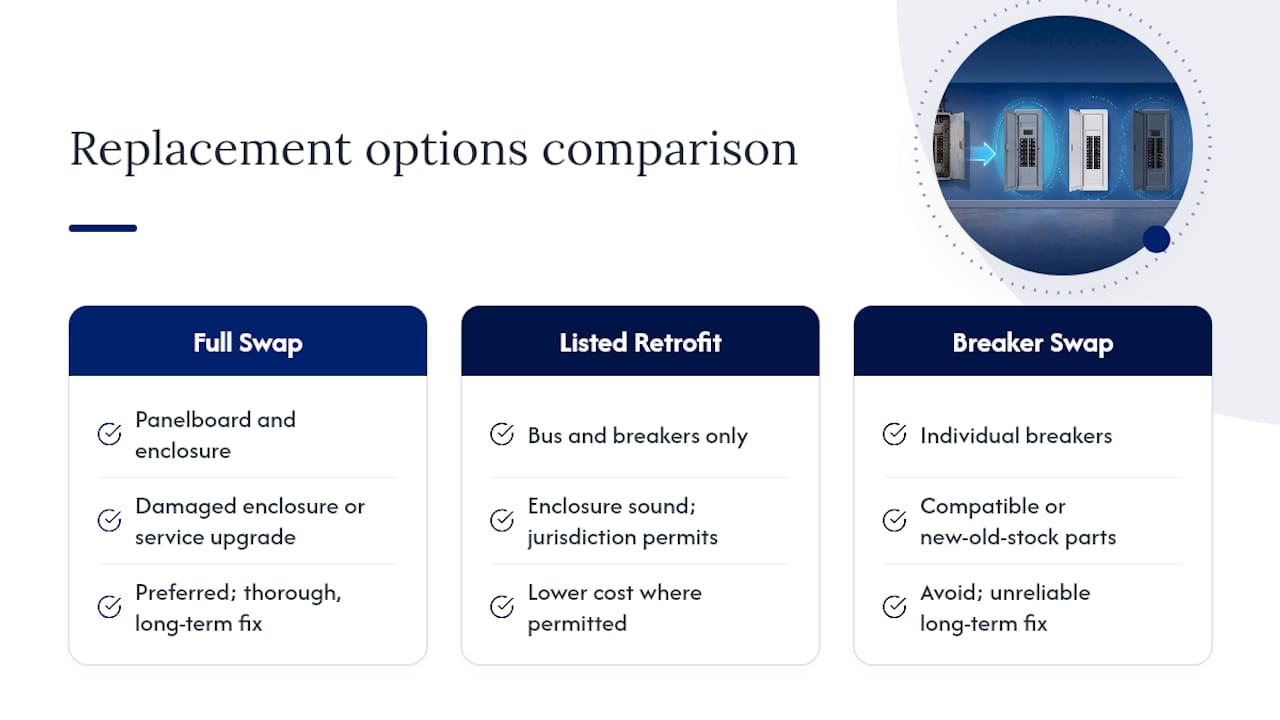
Full panel replacement pulls the entire panelboard and enclosure and installs a new, listed unit. This is the preferred route when the enclosure is damaged, undersized for your electrical load, or when you’re upgrading service size at the same time. It’s also the more thorough fix, since it resolves any hidden bus or enclosure issues along with the breaker problem.
Listed interior retrofit keeps your existing enclosure but replaces the bus and breakers inside it with a modern, code-listed system. Where local code and inspection allow it, this can bring the cost down noticeably since it skips the enclosure and sometimes wiring rework. The limit is that it’s only available where the enclosure itself is in good condition and your jurisdiction permits it, so ask early whether it’s even on the table for your home.
What you should not do is swap individual FPE breakers for “compatible” or “new-old-stock” replacements and call it solved. These parts often carry the same design issues that caused the original problem, and forensic reviewers have flagged them as an unreliable long-term fix rather than a genuine repair. If your electrician offers this as a permanent solution, treat it as a signal to get a second opinion.
For a closer look at how breaker-only swaps compare to full panel work, our circuit breaker replacement page walks through when each approach actually applies.
Permits, Inspections, and What to Expect
A typical job follows a predictable sequence:
- Licensed electrician inspects the panel and provides a written quote
- Contractor pulls the required permit with your local building department
- Panel replacement or retrofit work is completed on-site
- City inspector signs off before the panel is closed up and energized for normal use
Along the way, expect added tasks like grounding and bonding upgrades, AFCI or GFCI breaker additions, or minor conductor repairs. These can extend the timeline by a day or two but they’re standard, not a sign something went wrong. Keep every permit and inspection document. You’ll want it for insurance and for any future home sale.
Insurance and Real Estate: What to Expect From Insurers and Lenders
Insurers generally classify FPE panel replacement as routine maintenance, which means most won’t cover the cost of swapping it out. What they will often do is require the panel be replaced before issuing a new policy or renewing an existing one, since insurer guidance treats Stab‑Lok equipment as a documented hazard worth underwriting around.
On the real estate side, four-point inspections during a sale routinely flag FPE panels, and lenders can attach replacement as a condition of closing. That timeline pressure is exactly why sellers benefit from handling this before listing rather than scrambling during escrow.
A few practical steps protect you either way:
- Get a pre-emptive inspection and written quote before you list your home or renew a policy
- Keep permit and inspection paperwork organized in one place
- Ask your insurance agent directly whether your current panel affects your premium or renewal terms
Choosing a Licensed Electrician for Panel Replacement
Not every electrician handles FPE replacements the same way, so vet before you hire. Confirm the contractor is licensed and insured, ask whether they pull permits themselves, and request references from past FPE-specific jobs. Experience with this particular panel type matters more than general electrical experience.
- Ask for a written scope of work with itemized pricing, not a vague verbal estimate
- Confirm the timeline, including permit filing and the final inspection sign-off
- Ask about warranty coverage on both labor and parts
- Get the electrician’s license number and verify it independently if you’re unsure
Pro Tip: Treat any contractor who offers to install “replacement FPE breakers” as your permanent fix, skips the permit, or wants cash with no invoice as a red flag. Walk away and get a second quote.
What This Guide Recommends and Why
Homeowners often ask why a panel that hasn’t caused a visible problem needs urgent attention. The honest answer is that FPE Stab‑Lok failures tend to be invisible until they aren’t. A breaker that doesn’t trip looks identical to one that works fine, right up until it doesn’t stop an overload. That’s not a reason for panic, but it is a reason to stop treating “no obvious symptoms” as evidence of safety.
The CPSC’s decision not to recall these panels back in 1983 gets misread constantly as a clean bill of health. It wasn’t. It closed a specific investigation without mandating removal, which left the safety question in the hands of independent testers, insurers, and electricians ever since. Every one of those groups has landed in the same place: replace the panel, don’t patch it.
The company has built its reputation on straightforward, documented electrical work.
[Author bio placeholder]
— Van Castaneda
Get Your Federal Pacific Panel Inspected and Replaced
Unlike a breaker swap that leaves the underlying risk in place, a full panel upgrade from System Wide Services replaces the whole system with a modern, listed panelboard, so you’re not paying for a fix that forensic inspectors have already flagged as unreliable.
Booking starts with a licensed electrician visiting your home to inspect the existing panel and provide a written quote with itemized pricing. From there, System Wide Services handles the permit filing, does the replacement work, and coordinates the final inspection sign-off so you have complete documentation for your insurer or a future buyer. If the cost feels like a lot to take on at once, ask about financing options that let you spread payments over time instead of covering it in one lump sum. Reach out through the electrical services page to schedule an inspection and get your written quote started.
Sources
- Commission closes investigation of FPE circuit breakers (CPSC news release)
- Federal Pacific Electric (FPE) Stab‑Lok breakers and panelboards (The Hanover Insurance Group)
FAQ
How Much Does Federal Pacific Panel Replacement Cost?
A basic swap often runs in the low thousands, while a full replacement with a service upgrade or enclosure work can reach several thousand dollars, according to cost ranges from InspectAPedia. Your final price depends on amperage, grounding needs, and access to the panel.
Should a Federal Pacific Panel Be Replaced?
Yes. Independent testing has documented high failure-to-trip rates in FPE Stab‑Lok breakers, and forensic inspectors, insurers, and most licensed electricians recommend full replacement over any partial fix.
What Breakers Can Replace Federal Pacific Breakers?
Replacing individual FPE breakers, including new-old-stock units, is not considered a reliable long-term fix. The safer approach is a full panel replacement or a listed interior retrofit where local code permits it.
Does Homeowners Insurance Cover FPE Panel Replacement?
Usually not. Insurers typically treat this as routine maintenance the homeowner pays for, though many will require the panel be replaced before issuing or renewing coverage.
Recommended
Need a hand with this? We've got you covered.
System Wide Services handles plumbing, electrical, and handyman work across Long Beach and LA & Orange County.