
California Gas Line Permit: Pass the 2 Required Inspections
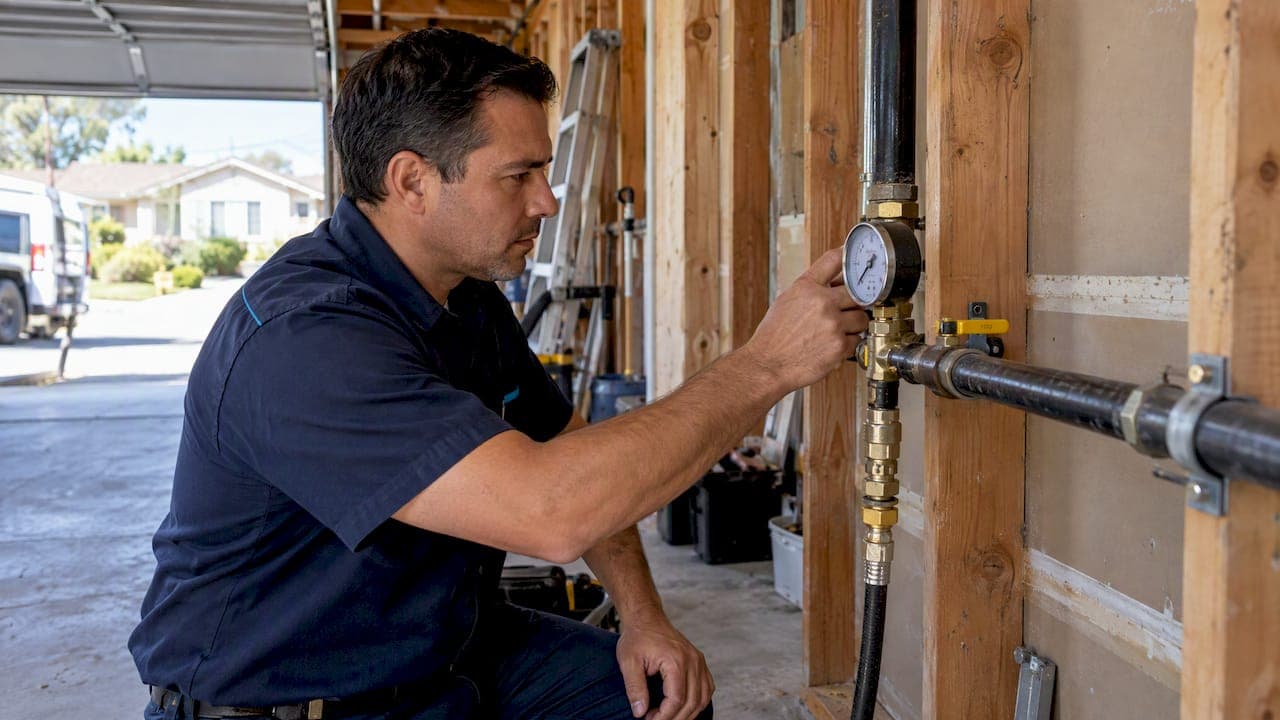
Yes, in California, installing, extending, or reconnecting gas piping requires a building or plumbing permit and a witnessed pressure test before you cover any pipe. Permits come from your local building department, called the Authority Having Jurisdiction (AHJ), and either you or a licensed plumber can apply. Your first move should be checking your city or county’s permit portal or calling a licensed plumber to start the paperwork before any pipe goes in the ground or wall.
TL;DR:
- A same appliance type replacement at the same location and connection may qualify for lighter review, but only your local building department can approve it.
- Your application should include a piping diagram, appliance BTU ratings, pipe materials, and load calculations; divide each BTU/h rating by 1,000 to estimate CFH.
- Inspectors must witness the rough pressure test before pipes are concealed; use a gauge marked in 0.1 pound increments, then schedule a final inspection.
- For underground runs, approved PE pipe needs tracer wire accessible at grade; CSST requires manufacturer installation documents, and added appliance load may require pipe upsizing.
Table of Contents
- Which Gas Projects Actually Need a Permit
- What to Prepare for Your Permit Application
- Passing Inspection: Pressure Tests and What Inspectors Check
- Materials, Depth, and Clearance Rules AHJs Enforce
- Avoiding Delays: Timeline, Cost, and Who Should Pull the Permit
- Field-Tested Steps That Get Permits Approved Faster
- Why Getting This Right Matters
- Getting Permit-Ready Gas Line Work Done Right
- FAQ
- Sources
Which Gas Projects Actually Need a Permit
Most gas work beyond a direct, like-for-like appliance swap needs a permit. A new dedicated line for a range, outdoor kitchen, fire pit, or standby generator counts as new gas piping, so it needs plan review and inspection. The same goes for adding a branch line or extending existing piping to feed another appliance, since that changes load and pipe sizing calculations.
Reconnecting or replacing a water heater, furnace, boiler, or fireplace insert usually triggers a permit too, especially when the work involves disconnecting and reconnecting gas piping rather than just swapping a unit on the same connection point. A straightforward quick swap, same appliance type, same location, same connection, sometimes qualifies for a lighter review, but your local building department makes that call, not a contractor’s guess.
Some jurisdictions offer temporary gas service or temporary construction permits for situations like a construction trailer or a staged remodel. If your project touches a dryer gas line, outdoor kitchen, or any appliance reconnection beyond a direct swap, assume you need a permit and confirm with your AHJ before work starts.
What to Prepare for Your Permit Application
A complete submittal on the first try saves weeks. Most California building departments want a filled-out building permit application paired with a gas piping plan, sometimes called an isometric or line diagram, showing the meter location, every run, pipe lengths, and diameters. Local handouts like the one from Danville spell out these exact submittal items, including appliance BTU ratings and total gas load.
You’ll need the BTU/h nameplate rating for every appliance on the line, then convert that to cubic feet per hour (CFH) by dividing BTU/h by 1,000. Add up the total CFH demand to confirm your pipe sizing supports every appliance running at once.
Your plan also needs to specify materials for each segment, Schedule 40 metallic pipe, CSST with the manufacturer’s installation documents attached, or approved PE for underground runs, and it should mark clearly which sections are new versus existing. Readers who want a deeper walkthrough of load calculation logic can find a practical breakdown in this plumbing load calculation guide.
Figures from San Bruno’s gas piping guidance give a sense of typical demand, though your actual nameplate values always take priority over estimates.

Passing Inspection: Pressure Tests and What Inspectors Check
Expect two inspections on a typical gas job: a rough inspection, which includes the pressure test, before anything gets covered, and a final inspection once every appliance connection is complete. The rough inspection is where most projects stall, so it’s worth understanding exactly what’s required.

According to Contra Costa County’s residential gas piping guidance, the pressure test typically requires holding pressure steadily for a duration without any drop. You’ll need a gauge with fine increments to provide the precision inspectors require, as a standard low-pressure dial gauge is insufficient.
The inspector shows up to witness the test, not just review paperwork. They’ll check pipe sizing against your submitted diagram, confirm materials match what you proposed, verify an accessible shutoff valve, and make sure nothing is buried or enclosed before they arrive.
Pro Tip: Schedule your inspection only after your test setup is staged and holding steady, calling too early and failing a test often means rescheduling and waiting again in the queue.
Materials, Depth, and Clearance Rules AHJs Enforce
California AHJs generally accept Schedule 40 metallic pipe for most residential runs, CSST when installed by someone trained on the manufacturer’s system with documentation included in the permit packet, and approved PE pipe for underground sections. San Bruno’s gas piping guidance outlines these material categories along with the underground cover depth generally required to provide adequate protection for buried piping.
PE piping requires a tracer wire accessible at grade to allow line location later, with missing tracers often leading to inspection failures. Above ground, piping needs proper support and grade clearance so it doesn’t sag or sit against surfaces that trap moisture.
Final connections to appliances have flex connector length limits, and every appliance needs an accessible shutoff valve within reach. If you’re adding load to an existing line, like installing a tankless water heater, you may need to upsize existing pipe sections to handle the higher BTU demand.
Avoiding Delays: Timeline, Cost, and Who Should Pull the Permit
Most permit rejections trace back to a handful of avoidable mistakes:
- No witnessed pressure test, or a test performed before the inspector arrived.
- The wrong gauge, lacking the 0.1-lb increments inspectors require.
- An incomplete piping diagram missing lengths, diameters, or BTU loads.
- Joints concealed in a wall or trench before the rough inspection happened.
Processing time varies by jurisdiction and backlog, so budget anywhere from a few days to a couple of weeks depending on your city’s plan-check queue and how complete your first submittal is. A pre-submittal consultation with your AHJ, when offered, can shave real time off that wait.
Either the property owner or a licensed contractor can pull the permit, but licensed plumbers who handle this paperwork regularly tend to submit cleaner applications and hit fewer rework cycles. Costs shift based on trenching and backfill needs, restoration work, how many appliances connect to the line, and whether existing piping needs upsizing.
Field-Tested Steps That Get Permits Approved Faster
Experienced installers build a simple pre-inspection routine: calibrated test gauge in hand, a photo log of the rough-in before anything closes up, appliance nameplates on file, a labeled piping diagram that matches what’s actually in the ground or wall, and a written test log showing pressure held for the full duration.
A clean submittal package, clearly labeled drawings distinguishing new from existing piping, sizing calculations shown rather than assumed, and manufacturer documentation attached for any CSST used, cuts down on plan-check back-and-forth. When a project is unusual or the local code interpretation is unclear, a short pre-submittal conversation with the AHJ can resolve questions before they turn into rejected plans.
Pro Tip: Keep your test log and permit paperwork in a dedicated folder. Escrow companies, insurance adjusters, and future buyers often ask for proof that gas work was permitted and inspected.
Why Getting This Right Matters
Permits exist because unpermitted gas work creates real safety risk, and it creates paperwork headaches down the line too. A missing permit can surface during escrow and stall a sale, or complicate an insurance claim if something goes wrong later. The process described above isn’t bureaucratic friction, it’s the same documentation trail that protects you if you ever need to prove the work was done correctly. Keep every test log and inspection record, because the folder you build during the permit process is the same one that saves you stress years later.
— Van Castaneda
Getting Permit-Ready Gas Line Work Done Right
We handle gas line installation and repair for homeowners across Los Angeles and Orange County, with Cerritos and Long Beach among the areas we serve most often, and permit coordination is part of how we approach every job. Because our team manages the piping diagram, BTU load calculations, and inspection staging in-house, you’re not stuck translating AHJ requirements yourself or chasing down a separate permit runner.
We show up with the necessary equipment, the paperwork staged correctly, and a plan built to pass the rough inspection the first time. If you’re planning a new gas appliance, an extension, or a reconnection, request an estimate through our gas line installation and repair page and we’ll walk you through what your specific project needs.
FAQ
Do I need a permit to install a new water heater in California?
Yes, water heater installation typically requires a permit in California, especially when gas piping is disconnected and reconnected as part of the swap. Our water heater permit guide covers the paperwork details that commonly affect escrow timelines.
What are the major changes in the California building code for 2026?
California’s Energy Code updates affect appliance replacement rules and electric-ready requirements, which can change what’s expected on a permit submittal for projects filed after specific effective dates. The California Energy Commission’s Blueprint guidance outlines updated compliance software and electric-readiness provisions that may apply to appliance swaps.
Do you need a permit to replace a furnace in California?
Furnace replacement generally requires a permit when the work involves reconnecting gas piping rather than a direct, same-location swap. Your local AHJ determines whether a specific furnace swap qualifies for simplified review.
Do you need a permit for a new boiler?
Yes, installing a new boiler typically requires a permit because it involves new or altered gas piping, appliance load calculations, and inspection of the connection. The same pressure-test and inspection rules that apply to other gas appliances generally apply here too.
How much does a gas line permit cost in California?
Permit fees vary by city and county, and project-specific costs depend on trenching, pipe upsizing, and the number of appliance connections involved. Contact your local building department for exact fee schedules, since there’s no single statewide rate.
Sources
- Residential Gas Piping (Contra Costa County)
- Residential gas line submittal requirements (Danville CA)
- Gas pipes information (San Bruno CA)
- Blueprint newsletter and Energy Code updates (California Energy Commission)
Recommended
Need a hand with this? We've got you covered.
System Wide Services handles plumbing, electrical, and handyman work across Long Beach and LA & Orange County.