
8 GFCI Locations California Homes Must Protect Under 2026 CEC
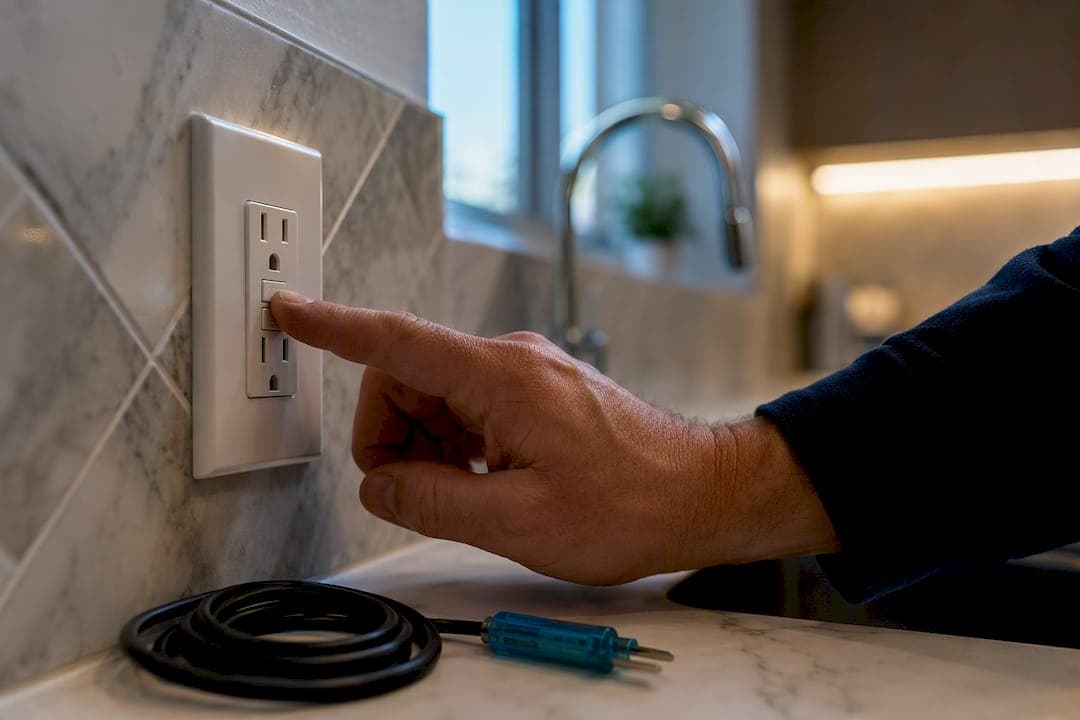
Under California’s governing code, the 2025 California Electrical Code (adopting NEC 2023 with state amendments, effective January 1, 2026), GFCI protection is mandatory in kitchens, bathrooms, garages, outdoor receptacles, laundry areas, basements, crawl spaces, and anywhere within 6 feet of a sink. You can satisfy this requirement with either a GFCI receptacle at the point of use or a GFCI breaker at the panel. Both methods carry equal weight under the code, so the choice comes down to your specific circuit layout and access needs.
TL;DR:
- GFCI protection is required in all bathrooms, kitchens, outdoor, garage, basement, laundry areas, and within 6 feet of any sink edge, whether receptacles serve appliances or outlets.
- The 6-foot requirement is based on the shortest realistic cord path, including around countertops, not a straight-line measurement, with some exceptions like HVAC circuits and rooftop outlets.
- Homeowners should choose between GFCI outlets and breakers based on circuit layout, total outlets, and ease of reset, with breakers favored for multiple outlets or hard-to-reach circuits.
- Regular monthly testing of GFCI devices is mandatory to ensure ongoing fault protection, with devices needing proper listing and accessible locations to meet code.
- Upgrading older wiring or outlets to current California standards is triggered by remodeling, new wiring, or permits, and professional inspection and permit handling are recommended before making changes.
Table of Contents
- Gfci Requirements California: Where Protection Is Mandatory
- How Is The 6-Foot Rule From A Sink Measured?
- GFCI Breaker Vs GFCI Outlet: Which Should You Choose?
- How Do You Test A GFCI Outlet Or Breaker?
- Which Code Edition Governs California Right Now?
- What Should Homeowners And Property Managers Do First?
- Local Expertise Behind This Guide
- A Practical Take On Panel Versus Outlet Protection
- Ready To Confirm Your Home Meets Current Code?
- Sources
- FAQ
Gfci Requirements California: Where Protection Is Mandatory
California’s electrical code doesn’t leave much room for guesswork once you know the list. The California Electrical Code requires GFCI protection at these locations and receptacle types:
- Bathrooms — every receptacle, no exceptions.
- Kitchens — all receptacles, not just countertop outlets, including those serving refrigerators, dishwashers, and disposals if cord-and-plug connected.
- Garages and accessory buildings at or below grade — this includes detached garages and storage structures.
- Outdoor receptacles — every outlet exposed to weather, per NEC 210.8(A) expansions.
- Basements and crawl spaces at or below grade, whether finished or unfinished.
- Laundry areas, including receptacles for washers.
- Any receptacle within 6 feet of a sink edge, in any room, not just kitchens and baths.
- Pool, spa, and hot tub adjacent equipment, plus boathouses and certain rooftop receptacles.
The biggest surprise for homeowners is usually the appliance list. Cord-and-plug connected appliances such as ranges, wall ovens, clothes dryers, and sump pumps fall under GFCI coverage, distinguishing them from hardwired connections. If you replaced a microwave or a garbage disposal recently and it plugs into an outlet instead of running through a hardwired junction, that receptacle likely needs protection now, even if it didn’t a decade ago.
How Is The 6-Foot Rule From A Sink Measured?
The 6-foot measurement isn’t a straight tape-measure line across the room. Inspectors use the shortest path a power cord would realistically follow along the floor and up the wall, without cutting through a wall, floor, ceiling, or fixed barrier like a permanent partition.
That distinction matters for kitchen islands and peninsulas. A receptacle on the far side of an island sink might sit more than 6 feet away in a straight line but well within the cord-path distance once you trace around the counter edge.
A few exceptions come up often:
- Receptacles dedicated to listed HVAC equipment can sometimes be exempt, depending on the specific circuit design.
- Ceiling receptacles designed to support fixture weight follow different rules than standard wall outlets.
- Rooftop receptacle accessibility has its own set of conditions under DSA Interpretation IR E-2.
When a layout is genuinely ambiguous, the Authority Having Jurisdiction (AHJ) can offer a site-specific ruling. AHJs frequently accept alternative methods that meet the underlying safety goal, so a licensed electrician’s proposal can sometimes avoid tearing out finished walls unnecessarily. If you’re unsure, get that confirmation in writing before the inspection, not after.
GFCI Breaker Vs GFCI Outlet: Which Should You Choose?
Both methods satisfy California’s code, but they solve different problems. A GFCI receptacle protects at the point of use and can also protect downstream outlets on the same circuit if wired correctly. A GFCI breaker protects the entire circuit from the panel outward, covering every device on that line automatically.
- GFCI outlets cost less per unit and work well for a single isolated circuit, like one bathroom receptacle.
- GFCI breakers simplify troubleshooting when multiple outlets share a circuit, since a trip shows up clearly at the panel instead of requiring you to hunt for a hidden reset button behind a refrigerator or entertainment center.
- Hardwired appliances covered under NEC 210.8(D) still need branch-circuit protection, and upstream breaker protection satisfies that requirement without adding a receptacle at all.
- Property managers juggling multiple units often lean toward breakers because tenants can identify and reset a tripped breaker far more easily than locating an outlet tucked behind a stove or washer.
Pro Tip: If you’re renovating a kitchen with several hard-to-reach receptacles behind appliances, ask your electrician about installing one GFCI breaker for the circuit plus a separate, easily accessible outlet just for monthly testing.
How Do You Test A GFCI Outlet Or Breaker?
California’s code requires GFCI devices to be “readily accessible,” meaning you shouldn’t need to move a refrigerator or unbolt a cabinet panel to reach one. A receptacle sealed behind built-in appliances or buried in a locked utility closet without a clear path doesn’t meet that standard.
Testing takes under a minute and should happen monthly:
- Plug in a lamp or small device to confirm the outlet has power.
- Press the Test button on the GFCI receptacle. The lamp should turn off immediately.
- Press Reset to restore power. If the lamp doesn’t come back on, the device has failed and needs replacement.
- For GFCI breakers, use the test button on the breaker itself, then flip it back to the “on” position following the manufacturer’s instructions.
Devices must be listed by a Nationally Recognized Testing Laboratory (NRTL) to count toward compliance. A GFCI that fails its monthly test isn’t just an inconvenience. It means the circuit has lost its fault protection entirely, even though the outlet still delivers power normally.
Which Code Edition Governs California Right Now?
The 2025 California Electrical Code, found in Title 24, Part 3, adopts the 2023 National Electrical Code with state-specific amendments, and it became effective January 1, 2026. Local building departments and inspectors, acting as the Authority Having Jurisdiction, enforce this edition on every new permit and most remodel work.
AHJs retain some flexibility. They can approve alternative methods when a proposed design meets the same safety intent as the written code, particularly on retrofit projects where full compliance would mean unreasonable demolition.
During permitted work, inspectors typically check for:
- GFCI protection at every required location listed in the code
- Correct labeling of protected circuits at the panel
- Accessible test and reset points on all devices
- Proper listing and rating of installed GFCI hardware
What Should Homeowners And Property Managers Do First?
Getting ahead of a code violation is far cheaper than fixing one after a failed inspection. Follow this sequence:
- Inventory every receptacle in your home or property, testing each GFCI monthly, and note which ones are hard to reach or missing protection entirely.
- Decide between breaker and outlet protection based on whether you’re dealing with one isolated circuit or several outlets that would benefit from centralized reset access.
- Pull permits for any circuit changes or new wiring, then schedule a licensed electrician and a follow-up inspection. Keep copies of every permit and inspection report for your records, since buyers and insurers often ask for them later.
Before hiring an electrician, confirm their license number through the California Contractors State License Board, ask about direct experience with 2025 CEC updates, and get a written scope of work. Confirm who handles the permit application and whether the quote includes warranty coverage and proof of insurance.
Pro Tip: Get a written cost estimate before work starts. Receptacle swaps and breaker installations vary widely in price depending on circuit complexity and panel age, so a clear scope avoids surprise charges once the electrician opens the panel.
Local Expertise Behind This Guide
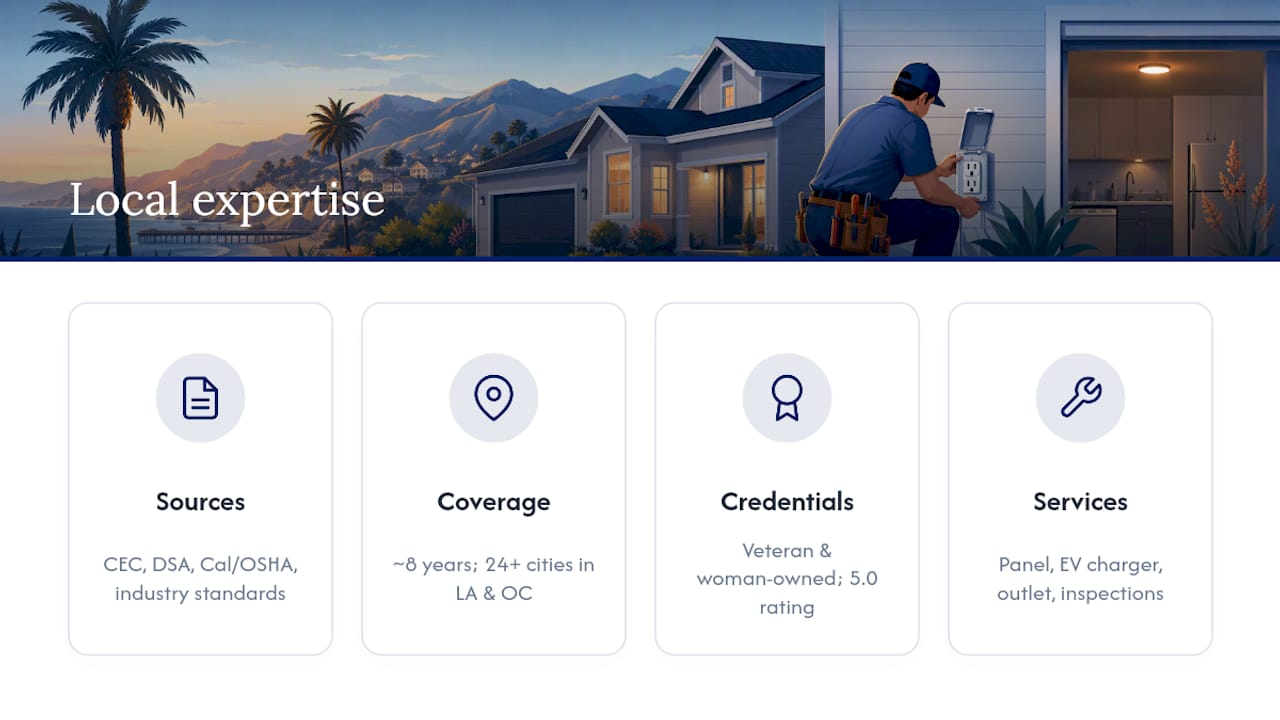
This guide draws on California Electrical Code text, DSA interpretations, and Cal/OSHA Title 8 regulations, cross-checked against industry standards for GFCI installation.
System Wide Services has spent roughly eight years handling electrical work across 24-plus cities in Los Angeles and Orange County, based out of Cerritos. As a veteran and woman-owned company with a 5.0 average customer rating, the team handles panel upgrades, EV charger installation, and outlet replacement daily, giving it direct familiarity with how local AHJs interpret and enforce GFCI rules on real job sites. For work that touches permits or code compliance, System Wide Services coordinates electrical inspections and pairs them with licensed electrician services built for exactly this kind of upgrade.
A Practical Take On Panel Versus Outlet Protection
Most homeowners overthink the breaker-versus-outlet decision. If a circuit feeds one appliance in a tight spot, a receptacle usually works fine. If it feeds several hard-to-reach outlets, a breaker saves headaches. Test monthly, and bring in a licensed electrician for anything permanent.
— Van Castaneda
Ready To Confirm Your Home Meets Current Code?
Testing your own outlets tells you whether they trip correctly, but it won’t tell you whether every required location actually has protection in the first place, and that gap is where most homes fall short of the 2025 CEC. System Wide Services offers electrical inspections, GFCI breaker and outlet installation, panel upgrades, and full permit handling across Long Beach and Orange County, so you get a licensed electrician who already knows what local inspectors check for.

If you’ve found even one ungrounded or hard-to-reach outlet using the testing steps above, that’s reason enough to get a professional opinion before it becomes an inspection failure during a sale or remodel. Schedule an electrical inspection or request a quote through our electrical services page to get a written scope and upfront pricing before any work begins. System Wide Services also offers financing options if you’re addressing multiple circuits at once.
FAQ
Where Is GFCI Protection Not Required?
GFCI protection generally isn’t required for dedicated circuits serving fixed appliances like refrigerators when hardwired rather than plugged in, or for receptacles more than 6 feet from a sink outside kitchens and bathrooms. Some listed HVAC equipment and specific ceiling-mounted receptacles also fall outside standard requirements.
Does Every Outlet In A Bathroom Need GFCI Protection?
Yes. California code requires every receptacle in a bathroom to have GFCI protection, with no exceptions for location or usage within that room.
How Many Outlets Can One GFCI Protect?
A single GFCI receptacle can protect multiple downstream outlets on the same circuit when wired correctly, and a GFCI breaker protects every outlet on that entire circuit from the panel. There’s no fixed numeric cap; it depends on the circuit’s amperage and load.
How Far Can An Outlet Be Before It Needs GFCI Protection?
Any receptacle within 6 feet of a sink’s edge, measured along the shortest path a cord would follow rather than a straight line, requires GFCI protection regardless of the room.
Do Existing Homes Need To Be Upgraded To Meet The 2025 CEC?
Generally, older installations are grandfathered under the code in effect when they were installed, but any remodel, new circuit, or permitted electrical work triggers compliance with the current 2025 CEC standards.
Recommended
Need a hand with this? We've got you covered.
System Wide Services handles plumbing, electrical, and handyman work across Long Beach and LA & Orange County.