
Do You Need a Water Heater Expansion Tank in California?
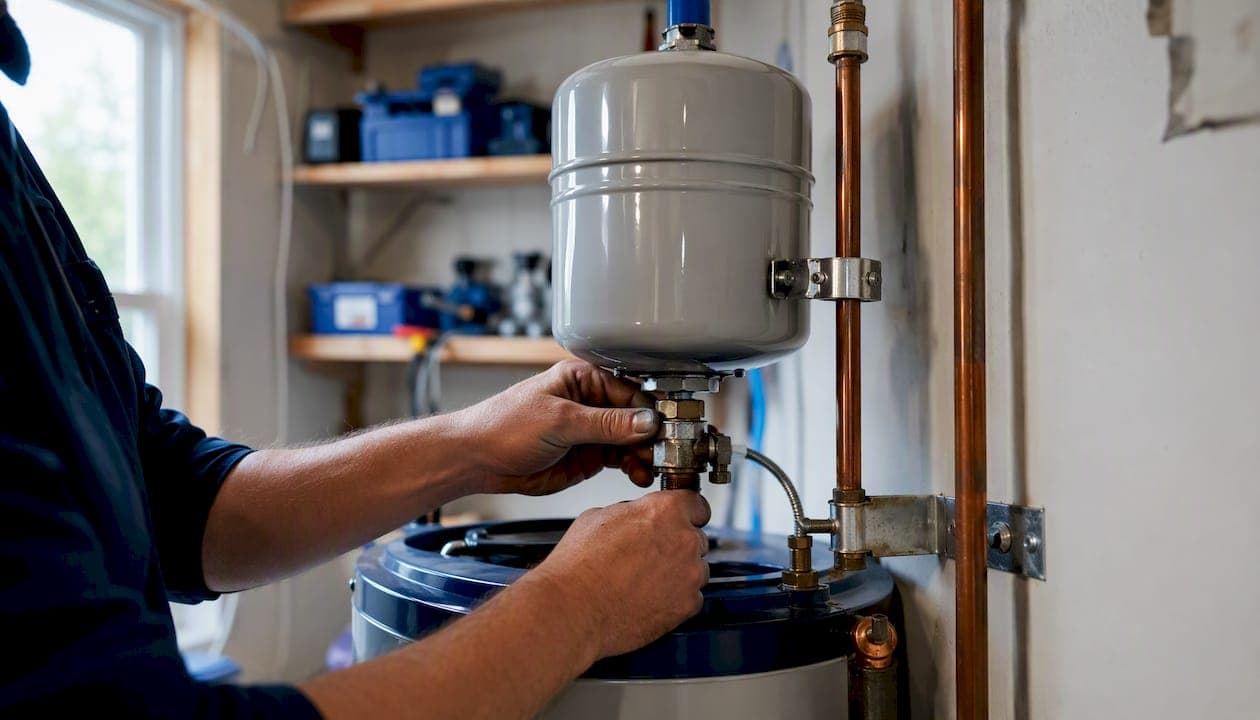
Yes. If your home has a closed plumbing system, California Plumbing Code Section 608.3 requires an approved expansion tank or equivalent device. California building departments enforce this alongside International Code Council guidance nationwide. A closed system is one with a pressure-reducing valve, check valve, or backflow preventer on the supply line, which is standard on most homes built or re-plumbed in the last two decades across Los Angeles and Orange County. Bradford White, one of the most common tank manufacturers installed in Southern California, explicitly warns against running a water heater in a closed system without thermal expansion control.
Here’s what to do right now, before you call anyone:
- Look at the cold-water line entering your water heater. If you see a small round canister (roughly the size of a football) mounted near the top, you likely already have expansion protection.
- Check whether water drips from the temperature and pressure (T&P) relief valve on the side of the tank. Dripping there is a safety signal, not a minor annoyance, and it usually means pressure has nowhere else to go.
- If you’re not sure whether your system is open or closed, or you can’t find an expansion tank at all, call a licensed plumber for an inspection rather than guessing.
Key Takeaways
A water heater expansion tank is required under California Plumbing Code Section 608.3 whenever a PRV, check valve, or backflow preventer creates a closed system, and skipping it typically shows up first as a dripping T&P relief valve.
| Point | Details |
|---|---|
| Code trigger | A PRV, check valve, or backflow preventer anywhere on your supply line makes your system closed under CPC 608.3. |
| Quick diagnostic | Check the cold inlet line near your water heater for a small tank, and tap it to listen for hollow versus dull sound. |
| Symptom to watch | A dripping T&P valve is usually a thermal expansion problem, not a faulty valve, and replacing the valve alone won’t fix it. |
| Sizing rule | Match tank size to water heater capacity and supply pressure using manufacturer charts from brands like Bradford White or Watts. |
| Next step | Schedule an inspection with a licensed plumber like System Wide Services to confirm your system status and permit needs. |
Table of Contents
- What Is a Water Heater Expansion Tank and Why Does It Matter?
- When Does California Code Require Expansion Protection?
- How Do You Know If You Need an Expansion Tank?
- How Are Expansion Tanks Sized and Installed?
- How Do You Maintain and Troubleshoot an Expansion Tank?
- How Do You Find a Licensed Plumber and Handle Permits?
- How Do You Calculate the Right Expansion Tank Size?
- Why We Treat Expansion Tanks as a Standard Safety Item
- Get a Code-Compliant Water Heater Expansion Tank Install
- Sources
- FAQ
What Is a Water Heater Expansion Tank and Why Does It Matter?
A water heater expansion tank is a small pressure vessel, usually mounted directly above or beside your water heater, that gives heated water somewhere to go when it expands. Inside, a rubber diaphragm or bladder separates two chambers: one holds pressurized air, the other connects to your plumbing. When water heats up and expands, it pushes into the water-side chamber, compressing the air on the other side of the bladder instead of slamming against your pipes, valves, and fittings.
The physics behind this is simple but often misunderstood. Water doesn’t compress, but it does expand as it heats, and in a standard 40 to 50-gallon residential tank, that expansion can add roughly 0.5 to 2 gallons of volume once the water reaches full temperature. In an open system, that extra volume just pushes back out through the main and dissipates into the municipal supply. In a closed system, it has nowhere to go, so pressure spikes instead.
That matters because this issue is specific to storage water heaters, the kind with a tank that holds and reheats water continuously. Tankless units heat water on demand and generally don’t create the same expansion problem, a distinction confirmed by the Department of Energy’s overview of gas water heater types. If your home runs a tankless system, most of what follows in this article doesn’t apply to you.
What the bladder actually accomplishes:
- Absorbs the extra 0.5 to 2 gallons of expanded water without letting system pressure spike above safe limits.
- Protects the T&P relief valve from constantly cycling open, which shortens its service life.
- Reduces stress on pipe joints, valve seats, and fixture supply lines that otherwise absorb repeated pressure surges.
When Does California Code Require Expansion Protection?
California Plumbing Code Section 608.3 requires an approved, listed, and adequately sized expansion tank (or other approved device) whenever a water system includes a check valve, backflow preventer, or other device that prevents pressure from dissipating back into the water main. In plain terms, if something in your plumbing blocks water from flowing backward toward the street, your system is closed, and code requires expansion control.
Local building departments across Los Angeles and Orange County enforce this consistently, and it comes up most often during water heater replacements, since that’s when inspectors and plumbers actually look at the supply line. A Town of Paradise building department handout summarizing this requirement notes that expansion tanks are normally installed on the building side of the backflow device or check valve, meaning between that device and your fixtures, not between the device and the street.
| Closed-system trigger | What it looks like at your home |
|---|---|
| Pressure reducing valve (PRV) | A bell-shaped valve on the main line, often near the water meter or where the line enters the house |
| Check valve | A one-way valve, sometimes built into the water heater’s cold inlet fitting |
| Backflow preventer | Required on some irrigation systems or water softener installs, often visible as a brass assembly near the meter |
| Municipal meter with integral check valve | Increasingly common in newer developments; not always visible without checking meter specs |
A few related code items come up whenever a water heater gets replaced, and missing any of them is a common reason inspections fail:
- The T&P relief valve (often a combination temperature and pressure relief valve) must be rated to discharge before tank pressure exceeds 150 psi.
- Discharge piping from the relief valve must run to an approved location, typically outdoors or to a drain, and can never have a shutoff valve installed between the relief valve and the discharge point.
- Nothing should ever cap or restrict the relief valve discharge line, regardless of how minor the drip seems.
If your home has any of the triggers listed above, expansion protection isn’t optional under California code. If none apply and your system is genuinely open, you may not need one, though a licensed plumber should confirm that before you skip it.
How Do You Know If You Need an Expansion Tank?
Start at the water heater itself. Follow the cold-water inlet pipe (it’s usually the one with a shutoff valve and sometimes a blue tag) back about a foot or two. If there’s a small tank branching off that line, roughly 2 gallons in size, sitting horizontally or vertically, that’s your expansion tank. Some older installs use alternative devices instead, like a specialized relief drain, though these are less common in residential retrofits than a standard tank.
Work through this sequence to figure out where you stand:
- Locate the cold inlet line and check for an expansion tank or alternate device.
- Trace the line back toward the street and look for a PRV, check valve, or backflow assembly.
- If you find a closed-system trigger but no expansion tank, you likely have a code gap that needs fixing.
- If the T&P relief valve drips or you hear water discharge periodically with no other explanation, treat that as a symptom of thermal expansion, not a valve defect.
- If you’re still unsure after this walkthrough, schedule a professional inspection rather than assume you’re fine.
Watch for these symptoms, since each one points to a specific likely cause:
- Dripping T&P valve: Often misdiagnosed as a failing valve, when the real cause is usually unmanaged thermal expansion in a closed system. Replacing the valve without adding expansion protection typically leads to repeat failures.
- Frequent relief discharge with no leak found: Suggests pressure is cycling above the relief threshold regularly, a classic closed-system signature.
- High-pressure fittings leaking elsewhere in the house: Toilet fill valves, washing machine hoses, and ice makers are often the first things to fail under expansion-driven pressure spikes.
- A dull “thud” instead of a hollow “tap” when you knock on the expansion tank: This usually means the tank is waterlogged and has lost its air charge.
For cost expectations, a standard residential expansion tank part typically runs in the low double digits to around $100, depending on size and brand, with labor adding to that if a plumber handles the install alongside other water heater work. A straightforward retrofit on an existing water heater is usually a same-day job. A permit is typically required when the work is tied to a full water heater replacement, since that triggers a full code review of the installation, though a standalone expansion tank retrofit on an otherwise-compliant system may not always need a separate permit. Check with your local building department to confirm.
How Are Expansion Tanks Sized and Installed?
Sizing an expansion tank depends on three inputs: your water heater’s storage capacity, your home’s incoming supply pressure, and the pressure rating of your relief valve. A 40-gallon heater on a system with moderate supply pressure needs a smaller tank than an 80-gallon commercial-style unit on a high-pressure line, and manufacturer selection charts from brands like Watts and Bradford White map these combinations directly, which is the fastest way to confirm a plumber’s tank choice is correct rather than eyeballing it.
Installation location matters as much as sizing. The tank goes on the cold-water inlet, on the building side of any check valve, backflow preventer, or PRV, meaning between that device and the water heater. InterNACHI’s inspection guidance recommends horizontal mounting with proper support brackets in most residential setups, since a fully water-filled tank has real weight, and an unsupported horizontal mount stresses the pipe fitting it hangs from over time. Whichever orientation your installer chooses, the tank needs enough clearance for gravity drainage back toward the heater if it’s ever serviced.
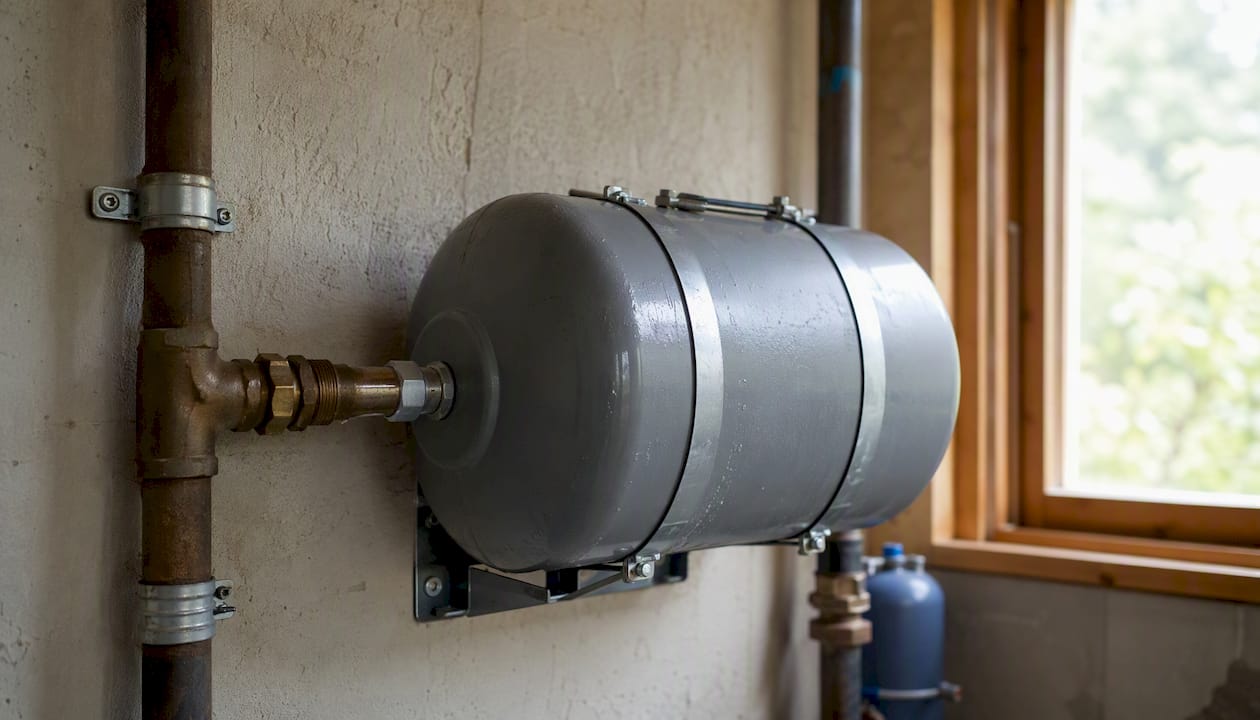
Precharge is the part homeowners overlook most. The tank’s internal air pressure should match your home’s static supply pressure, not some default factory setting, and most tanks arrive precharged to a standard figure that rarely matches your actual line pressure. If your incoming supply pressure runs above about 80 psi, you need a pressure-reducing valve installed before the expansion tank, since most residential tanks and fixtures aren’t rated to handle sustained pressure that high. Tank pressure ratings typically top out around 150 psi.
Pro Tip: Ask your installer to check your static water pressure with a gauge at an outdoor spigot before setting precharge. Some installers skip this and just leave the factory setting in place, which means your expansion tank may be undersized for your actual line pressure from day one.
How Do You Maintain and Troubleshoot an Expansion Tank?
Once a year, before your water heater’s typical maintenance check, run through a quick physical inspection. Shut off the cold-water supply to the heater first, and relieve system pressure by opening a hot water tap somewhere in the house. Only then check the Schrader valve, the small air valve on the tank that looks like a tire valve stem. Measuring precharge under pressure gives a meaningless reading, so this step order matters.
Follow this sequence for the annual check:
- Shut off the cold-water supply line to the water heater.
- Open a hot water faucet to relieve pressure in the system.
- Tap the side of the expansion tank. A hollow sound means the air chamber is intact; a dull thud means it’s likely waterlogged.
- Check the Schrader valve with a standard tire pressure gauge and compare the reading to your home’s static supply pressure.
- If water sprays out of the Schrader valve instead of air, the bladder has failed and the tank needs replacement, not recharging.
A few common problems and what they usually mean:
- Continuous drip from the T&P valve: Check for a waterlogged expansion tank before replacing the relief valve itself.
- Tank sounds solid when tapped: The bladder has likely ruptured; recharging won’t fix this, only replacement will.
- Low or zero pressure reading at the Schrader valve with a hollow tank sound: The tank may just need recharging with air, which is a quick fix compared to full replacement.
- Water discharge from the relief valve immediately after a hot water heater refill or repair: Confirm the expansion tank was reconnected and precharged correctly during the work.
How Do You Find a Licensed Plumber and Handle Permits?
Permits are typically required in California whenever expansion tank work accompanies a full water heater replacement, since inspectors review the entire installation for code compliance at that point, including relief valve discharge routing and expansion protection. A standalone retrofit on an already-compliant system sometimes skips a separate permit, but your local building department has the final say, and it varies by city even within Los Angeles and Orange County.
Before hiring anyone, ask these questions directly:
- Are you licensed and insured to do plumbing work in this city?
- Are you familiar with California Plumbing Code Section 608.3 and how it applies to my specific setup?
- Will you handle the permit application, or is that on me?
- Will you follow the manufacturer’s installation instructions for the specific tank you’re installing?
- Will you pressure-test the system and clean up the old tank and materials after the job?
Watch for these red flags, since any one of them should send you looking elsewhere:
- A quote that conveniently skips mentioning a permit at all.
- A plumber who suggests capping or restricting the T&P discharge line to “stop the dripping.”
- No mention of pressure testing before calling the job finished.
- Any offer to avoid or delay inspection to save time or money.
If you’re weighing options for backflow-related questions specifically, this backflow preventer FAQ resource covers how backflow devices function and why they trigger the closed-system requirement in the first place. For homeowners in the South Bay looking for a licensed local option, Torrance residential plumbing services from System Wide Services include full permit handling as part of water heater work, so you’re not left chasing down city paperwork yourself.
How Do You Calculate the Right Expansion Tank Size?
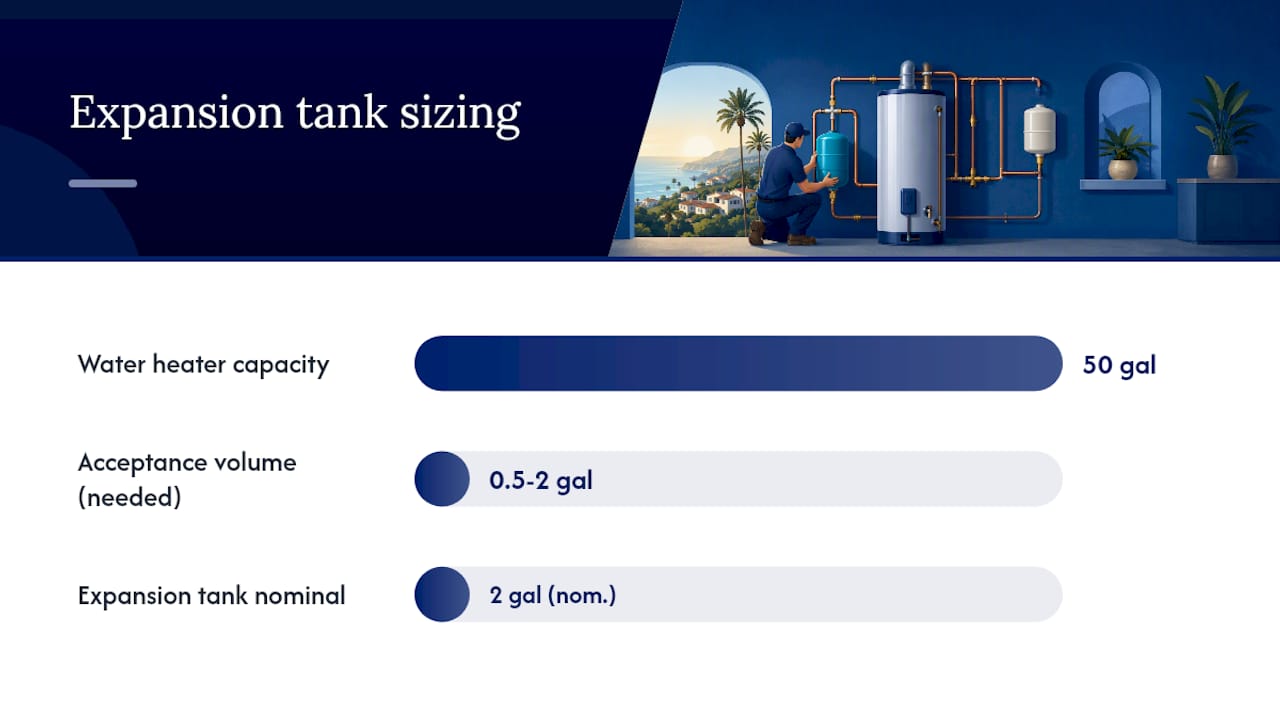
Manufacturer selection charts remain the final word on sizing, but the underlying formula is straightforward enough to sanity-check a plumber’s recommendation yourself. The calculation weighs your water heater’s storage volume, the temperature rise (delta-T) from incoming cold water to your set temperature, your home’s static supply pressure, and your relief valve’s maximum pressure setting. The result is called the “acceptance volume,” which is the amount of expanded water the tank actually needs to absorb, and it’s always smaller than the tank’s total gross volume, since some of that gross volume holds the precharged air.
Here’s a worked example using figures typical for a common Southern California home:
| Input | Typical value | Effect on sizing |
|---|---|---|
| Water heater capacity | 50 gallons | Larger tanks need proportionally larger expansion tanks |
| Temperature rise (delta-T) | Cold supply to roughly 140°F setpoint | Higher delta-T increases expansion volume |
| Static supply pressure | 60 psi (typical municipal range) | Higher pressure requires more precharge and can require a PRV above 80 psi |
| Relief valve setting | 150 psi maximum | Sets the ceiling the expansion tank must keep pressure under |
| Expected acceptance volume | Roughly 0.5 to 2 gallons | Matches the thermal expansion range for tanks in this capacity class |
For a 50-gallon heater under these conditions, a standard 2-gallon nominal expansion tank generally covers the acceptance volume with margin to spare, which is why it’s the most common size installed in single-family homes across the region. Manufacturer selection guides remain the correct final authority, since larger heaters, unusual delta-T, or higher supply pressure can shift the right tank size up a category. Always verify against the actual chart for your specific water heater and tank brand, and let a licensed plumber confirm before the install locks in.
Why We Treat Expansion Tanks as a Standard Safety Item
Expansion tanks don’t get the attention they deserve because the failure mode is quiet. A dripping T&P valve looks like a minor nuisance until you understand it’s a pressure relief system doing exactly what it’s designed to do, repeatedly, because nothing upstream is absorbing the expansion it’s compensating for. That’s not a valve problem. It’s a missing safety device problem, and treating the symptom instead of the cause is how homeowners end up replacing the same relief valve two or three times over a few years.
We see this pattern often enough across Cerritos, Long Beach, and the surrounding Los Angeles and Orange County cities we serve that we treat expansion protection as a standard line item on every water heater installation and replacement, not an upsell. California code backs this up directly through Section 608.3, and manufacturers back it up through their own installation instructions, so there’s no credible argument for skipping it on a closed system. Our licensed plumbers handle the permit process and code verification as part of the job, which is the part most homeowners don’t want to navigate alone anyway.
Get a Code-Compliant Water Heater Expansion Tank Install
A properly sized, correctly installed expansion tank is a small part of a water heater job, but it’s the part that determines whether your installation actually passes inspection and protects your plumbing long-term. System Wide Services handles the full scope on every water heater project: system inspection to confirm whether your setup is open or closed, correct tank sizing against manufacturer charts, permit handling with your local building department, full installation and pressure testing, and disposal of your old tank or unit.
If you’re in Long Beach, Torrance, Seal Beach, Hermosa Beach, Lakewood, La Palma, Cerritos, or another city across our Los Angeles and Orange County service area, you can request a same-day or scheduled appointment for an inspection or estimate. We also offer financing options and a membership program for homeowners who want priority scheduling on future plumbing, electrical, or handyman work. Start with a plumbing services request if you’re not sure which local page applies, or go directly to your Long Beach residential plumbing page if that’s your city. Either way, the next step is simple: request your inspection and we’ll tell you exactly where your system stands.
Sources
- What is thermal expansion?
- HotWater101: Installing a Thermal Expansion Tank (Whirlpool Water Heaters)
- Water Heater Expansion Tanks - InterNACHI®
FAQ
Is an Expansion Tank Required for a Water Heater in California?
Yes, whenever your plumbing system is closed, meaning it includes a PRV, check valve, or backflow preventer, California Plumbing Code Section 608.3 requires an approved expansion tank or equivalent device.
What Are the New Rules for Water Heaters in California?
Current code enforcement continues to focus on closed-system triggers under CPC 608.3, requiring expansion protection, proper relief valve discharge routing, and a 150 psi maximum relief valve setting on any replacement or new installation.
Do I Really Need an Expansion Tank on My Water Heater?
If your home has a PRV, check valve, or backflow preventer anywhere on the cold supply line, yes, and skipping one typically leads to a dripping T&P valve or fixture leaks elsewhere in the house.
Are Water Heater Expansion Tanks Required by Code?
Yes, in any California home with a closed plumbing system; the requirement comes directly from CPC Section 608.3, and inspectors check for it during water heater replacement permits.
How Do I Know if My Expansion Tank Has Failed?
Tap the tank and listen: a hollow sound means the air chamber is fine, while a dull thud usually means the bladder has failed and water has waterlogged the tank, a common cause of repeated relief valve discharge.
Recommended
Need a hand with this? We've got you covered.
System Wide Services handles plumbing, electrical, and handyman work across Long Beach and LA & Orange County.