
Low VOC Paint Benefits: What Homeowners Actually Gain
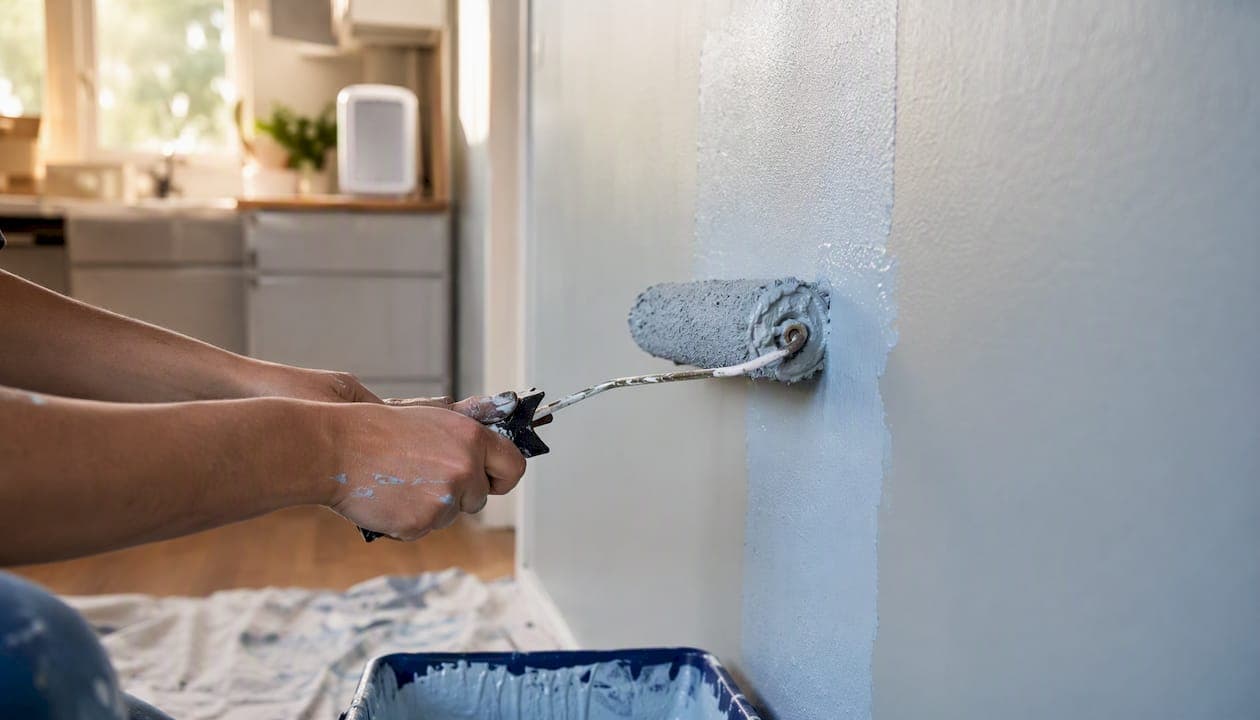
Yes, low-VOC paint meaningfully reduces indoor fumes and odor, and for occupied rooms, it’s usually the smarter pick. You get healthier indoor air, faster re-occupancy, and fewer emissions tied to smog formation. The one caveat worth remembering: a “low-VOC” label isn’t a chemical-free guarantee, and ventilation still matters no matter what’s on the can. The EPA, the Building America Solution Center, and the American Chemical Society all back this up with real testing data, not marketing copy.
For bedrooms, nurseries, and any space you’ll sleep or work in soon after painting, low-VOC formulas earn their keep. Here’s what you’re gaining:
- Lower short-term irritation risk (headaches, eye and throat irritation)
- Faster odor clearance and quicker safe re-occupancy
- Reduced contribution to outdoor smog and ground-level ozone
- Comparable durability to standard paints in most modern formulations
Key Takeaways
Low-VOC paint reduces short-term indoor air irritants and speeds up safe re-occupancy, but ventilation and third-party certification still determine how much benefit you actually get.
| Point | Details |
|---|---|
| Health benefit is real but bounded | Low-VOC paint cuts short-term irritants, but labels aren’t a chemical-free guarantee, per ACS lab findings. |
| Ventilation matters most | Cross-ventilation and fans for the full re-occupancy window do more than the paint choice alone. |
| Watch the tinting | Standard colorants can add VOCs back into a zero-VOC base, so ask about low-VOC tinting systems. |
| Certifications beat content claims | California 01350-based emissions testing tells you more than a VOC-content number on the can. |
| Hire a pro for complex jobs | System Wide Services handles prep, primer selection, and ventilation planning for occupied Cerritos and Long Beach area homes. |
Table of Contents
- Health Benefits of Low VOC Paint and Indoor Air Quality
- How Does Low VOC Paint Reduce Environmental Impact?
- How Long Before You Can Sleep in a Freshly Painted Room?
- Does Low VOC Paint Perform as Well as Traditional Paint?
- Is Low VOC Paint Worth the Extra Cost?
- Certifications and Labels Worth Trusting
- Step-by-Step: Application and Cleanup for Lower Exposure
- Sources
- FAQ
Health Benefits of Low VOC Paint and Indoor Air Quality
Indoor VOC levels can run up to 10 times higher than outdoor air during and right after painting, and that spike is what causes the classic “new paint” symptoms: headaches, nausea, and eye, nose, or throat irritation. Reducing the VOC load in your paint reduces that spike. That’s the core mechanism behind every health benefit of low VOC paint you’ll read about.
Quick reference: Industry classification puts “low-VOC” paint below 50 grams per liter and “zero-VOC” below 5 grams per liter. These are formulation thresholds, not safety certifications, so treat them as a starting filter rather than a finish line.
Here’s the wrinkle nobody puts on the paint can: a 2024 American Chemical Society lab analysis of 40 water-based paints found measurable VOCs and semi-volatile organic compounds even in products marketed as low- or zero-VOC. That doesn’t mean the label is meaningless. It means:
- “Low-VOC” and “non-toxic” are not the same claim
- Ventilation and certification still matter after you buy the can
- Sensitive household members (kids, pregnant people, anyone with chemical sensitivities) benefit most from pairing low-VOC paint with extra air changes
If someone in your home falls into that sensitive group, don’t rely on the label alone. Combine the paint choice with the ventilation steps below.
How Does Low VOC Paint Reduce Environmental Impact?

Paint VOCs don’t just affect the room you’re standing in. Once they off-gas outdoors or through open windows, they react with nitrogen oxides in sunlight to form ground-level ozone, the main ingredient in summer smog. That’s exactly why the EPA regulates architectural coatings at the federal level, capping VOC content by coating category to cut emissions nationwide.
What that regulation buys your neighborhood:
- Fewer smog-forming compounds released during peak painting season (spring and summer)
- Lower cumulative VOC load from millions of individual paint jobs, not just yours
- A baseline that pushes manufacturers toward cleaner formulations across the board
One limitation worth flagging: outdoor-focused VOC limits target smog precursors specifically. That’s a different lens than the indoor air quality concerns this article is mostly about, so a paint that scores well on smog reduction won’t automatically score well on indoor emissions testing.
How Long Before You Can Sleep in a Freshly Painted Room?
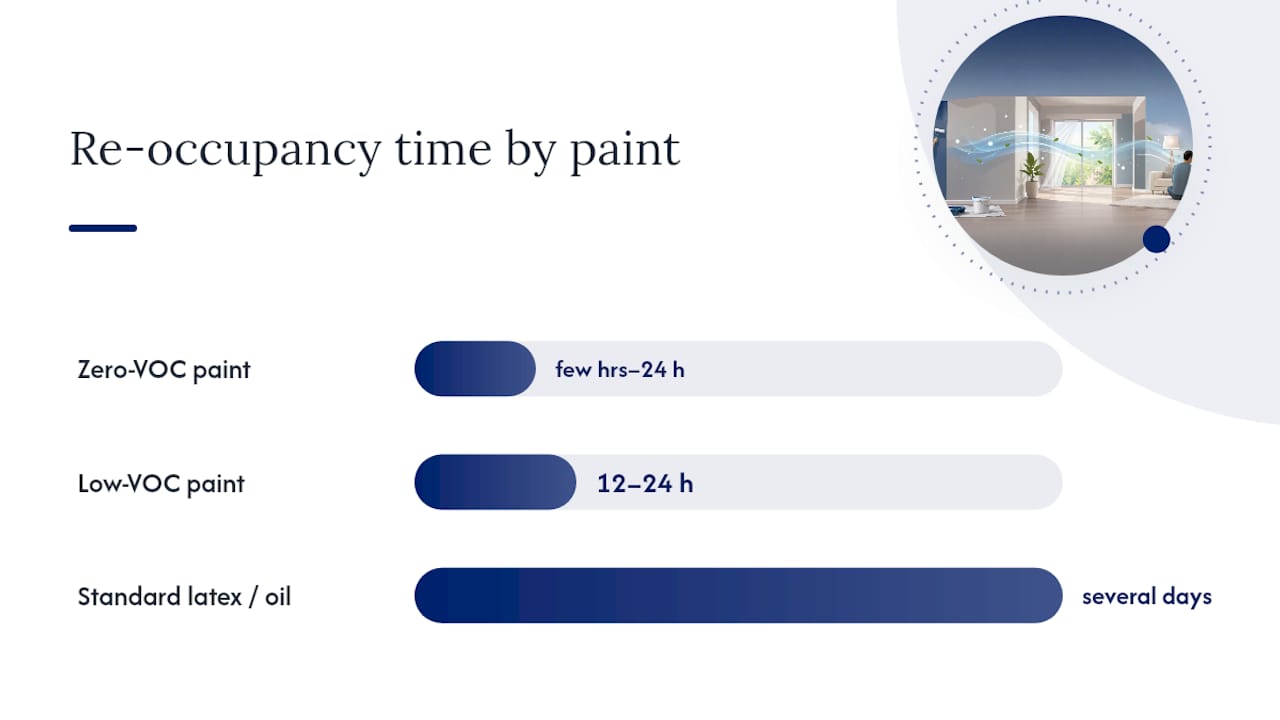
This is the question every homeowner actually wants answered, and the honest response is “it depends on the paint and the room.” Zero-VOC paints typically clear enough to re-occupy within a few hours to 24 hours. Low-VOC paints usually need 12 to 24 hours. Standard latex or oil-based paints can take longer, sometimes several days, especially in humid or poorly ventilated rooms. Heat and humidity slow off-gassing further, so a bathroom repaint in August behaves differently than a bedroom in a dry winter.
One detail that trips people up: tinting adds VOCs. A “zero-VOC” base can pick up measurable VOC content once a standard colorant goes in, so ask your paint counter whether they carry a zero-VOC tinting system before you commit to a color.
To shorten the timeline regardless of paint type:
- Open windows on opposite sides of the room for real cross-ventilation, not just one cracked window.
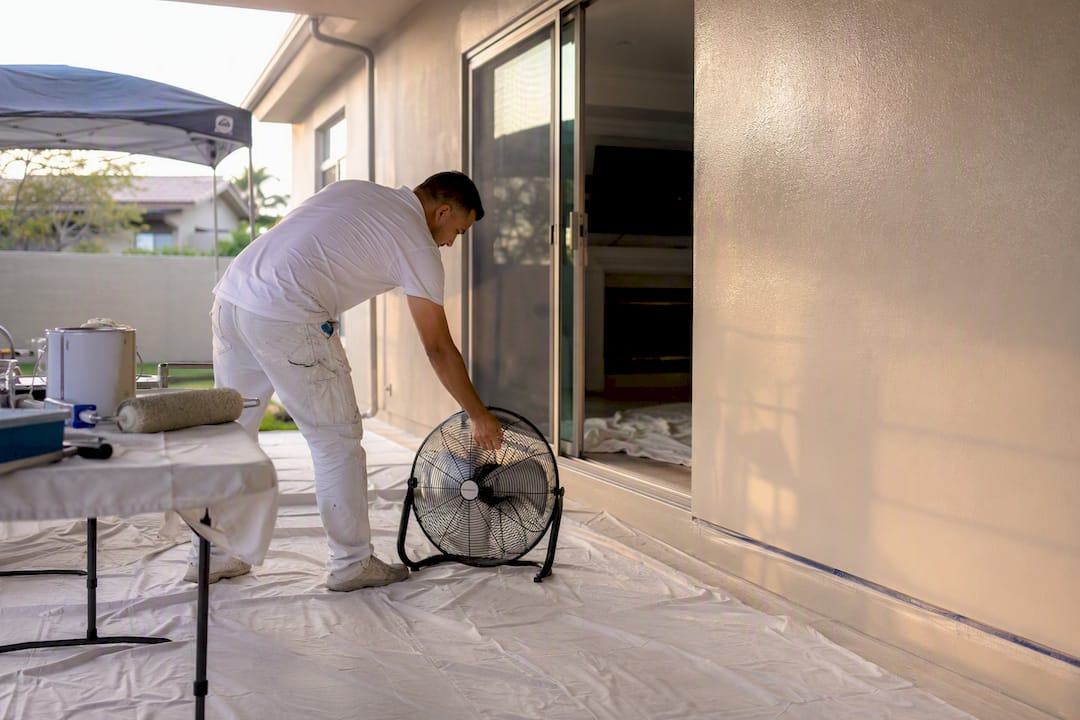
- Run box fans facing outward to actively pull fumes out rather than just stirring the air.
- Add a HEPA air purifier with an activated carbon layer if anyone in the house is sensitive.
- Keep the ventilation running for at least the full re-occupancy window, even after the paint feels dry to the touch.
Pro Tip: Dry to the touch doesn’t mean fully cured. Surface-dry paint can still off-gas for hours, so keep the fans running past the point where the wall looks finished.
Does Low VOC Paint Perform as Well as Traditional Paint?
This is where a lot of DIYers get nervous, and the short answer is that most modern low- and zero-VOC formulations hold up fine. Some facility-scale projects have reported needing an extra coat or a different primer to hit the same coverage as traditional paint, particularly over darker existing colors or bare drywall. That’s a planning issue, not a durability issue.
To avoid rework:
- Prime bare or heavily patched drywall before your topcoat, even if the paint claims “self-priming”
- Test your color on an actual sample board, not just the chip, since low-VOC formulas can shift slightly in sheen
- Budget for a possible second coat on high-contrast color changes
- Save higher-performance (often not zero-VOC) products for trim, doors, and high-traffic areas where scuff resistance matters more than off-gassing time
Certifications discussed below can help you spot which low-VOC lines have actually been tested for performance parity, not just chemical content.
Is Low VOC Paint Worth the Extra Cost?
Expect a modest per-gallon premium for low- and zero-VOC lines, generally in the range that some facility studies have pegged at 5 to 15 percent above standard paint, though pricing varies by brand and region. On a typical bedroom, that premium might cost you the equivalent of a few extra dollars per gallon, not a budget-breaker.
Weigh that against what you’re avoiding:
- A displaced night or two if a sensitive household member can’t tolerate standard paint fumes
- The cost of running a rental air purifier or extra fans for several days
- Potential rework if you skip primer and need a third coat regardless of paint type
Practical budgeting tips: buy a quality mid-range low-VOC line rather than the cheapest option, test a small area first, and price the primer into your total, not just the topcoat.
Certifications and Labels Worth Trusting
Not every green claim on a paint can means the same thing, and knowing the difference saves you from paying for marketing instead of testing.
- Green Seal and Greenguard Gold evaluate different things: content limits versus actual chamber emissions testing, so check which standard a product actually cites.
- California 01350-based emissions testing, the standard behind programs like Indoor AirPlus, measures what actually comes off the paint in a sealed chamber, which is a more direct proxy for indoor air quality than VOC-content numbers alone.
- Ask for the product’s Safety Data Sheet if a certification isn’t listed on the can. Reputable manufacturers will provide one on request.
- Skip heavily tinted “zero-VOC” bases unless the retailer confirms a zero-VOC colorant system, since tinting is the most common way VOCs sneak back into a supposedly clean product.
Step-by-Step: Application and Cleanup for Lower Exposure
Getting the health and odor benefits of low VOC paint depends as much on technique as on the can you buy.
- Before painting: Clear sensitive items and anyone with respiratory concerns out of the room, lay drop cloths, and wear a mask if you’re sanding old paint or drywall dust.
- During painting: Keep windows open on two sides of the room, run box fans facing outward, and use the primer the manufacturer recommends rather than skipping it to save a step.
- After painting: Ventilate for the full recommended window based on your paint type, run a HEPA or activated-carbon air purifier if you have one, and confirm disposal rules locally. Fully dried low-VOC latex paint is often accepted as regular household waste rather than hazardous material, though local rules vary.
Pro Tip: Keep leftover paint cans sealed and labeled with the room and date. If you ever need a touch-up, matching the original formula avoids introducing a different VOC profile into an otherwise settled room.
If humidity in the space is fighting your ventilation efforts, it helps to understand how mold and moisture affect indoor air quality before you seal the room back up.
A Practical Note From the Editor
Most articles on this topic treat “low-VOC” as a finish line. It’s a starting point. The real payoff comes from combining a low-VOC or zero-VOC product with actual ventilation discipline, not from the can alone. Homeowners who skip the fan-and-window step and assume the label does all the work are the ones who end up with a headache two days into a “safe” paint job.
Where I’d push back on conventional advice: don’t over-index on chasing the absolute lowest VOC number on the shelf if it means sacrificing coverage and forcing a third coat. Two coats of a well-reviewed low-VOC paint with proper ventilation beats three coats of the cheapest zero-VOC option with the windows shut. For complex prep work, like skim-coating old walls, matching primers to tricky surfaces, or painting around household members with real chemical sensitivities, this is exactly where hiring a pro who plans ventilation and primer selection ahead of time pays off.
Let System Wide Services Handle the Prep, Primer, and Painting
Doing it yourself means researching primers, testing sample boards, and hoping your ventilation setup is enough. System Wide Services skips that guesswork for you: our crews already know which primers pair with which low-VOC lines, how to prep drywall so you don’t end up needing a third coat, and how to plan ventilation so your family gets back into the room faster.

As a veteran and woman-owned company serving Cerritos, Long Beach, and surrounding Los Angeles and Orange County communities, System Wide Services handles drywall repair, painting, trim work, and full prep from a single crew, backed by a 5.0 average customer rating. Whether you’re repainting a nursery before a new baby arrives or refreshing a whole-home interior, our handyman services cover the prep, priming, and application so you’re not the one testing sample boards on a Saturday. Reach out to check availability in your area and get a quote for your next painting project.
Sources
- What are volatile organic compounds (VOCs)? | US EPA
- Water-based paints: Less stinky, but some still contain potentially hazardous chemicals - American Chemical Society
- Certified low/no emission interior paints and finishes | Building America Solution Center
FAQ
What Are the Benefits of Low VOC Paint?
Low VOC paint reduces short-term irritants like headaches and eye or throat irritation, clears odor faster, and contributes less to outdoor smog formation than traditional paints.
Is It Okay to Sleep in a Room With Low VOC Paint?
Zero-VOC paint is generally safe to sleep near within a few hours to 24 hours with proper ventilation, while low-VOC paint typically needs 12 to 24 hours to clear enough for comfortable re-occupancy.
Do I Really Need to Worry About VOCs?
If you’re painting an occupied bedroom, nursery, or space used by someone with respiratory sensitivities, yes, VOCs are worth managing through paint choice and ventilation; for unoccupied exteriors, the practical risk is much lower.
Is Low VOC Paint Worth the Extra Cost?
For most occupied living spaces, yes. The modest per-gallon premium is usually smaller than the cost of displaced nights, extra ventilation equipment, or potential rework from skipping primer.
How Is Low VOC Paint Different From Zero VOC Paint?
Low-VOC paint typically contains under 50 grams per liter of VOCs, while zero-VOC paint contains under 5 grams per liter, though tinting can raise the actual VOC content of either type.
Recommended
Need a hand with this? We've got you covered.
System Wide Services handles plumbing, electrical, and handyman work across Long Beach and LA & Orange County.