
Burst Pipe Emergency: What to Do Right Now
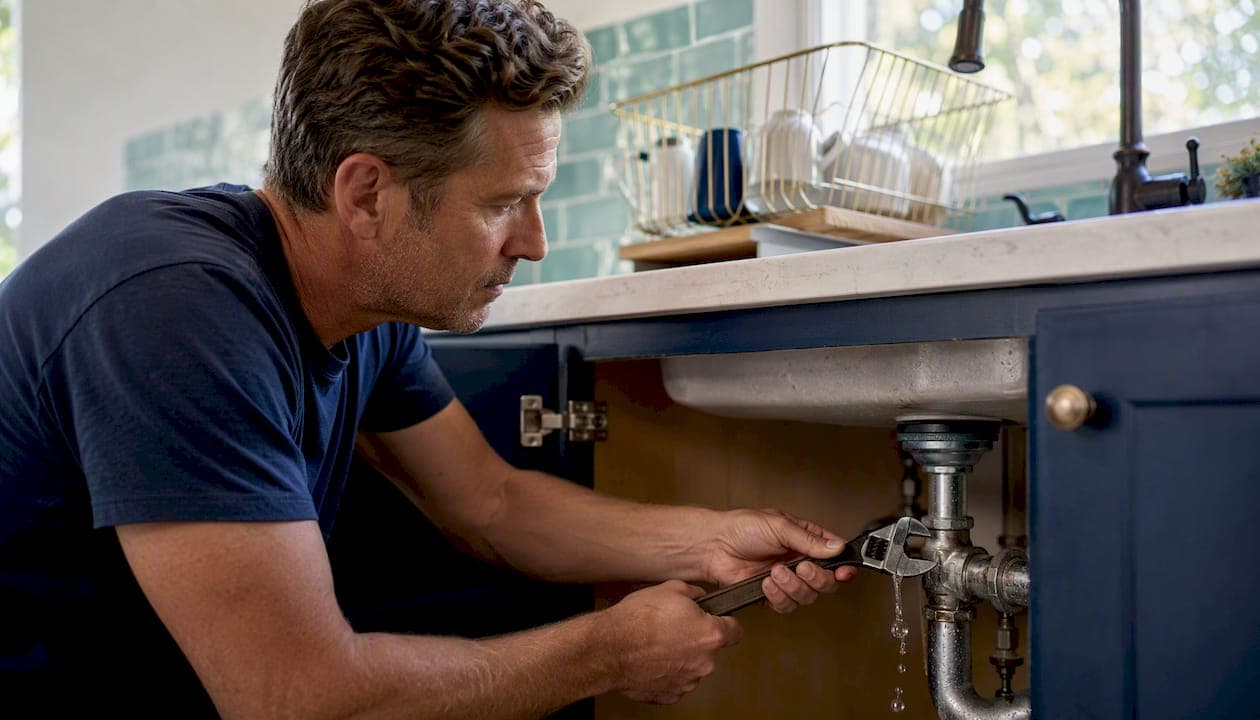
If a pipe has burst in your home, stop the flow immediately: shut the main water, keep everyone away from wet electrical areas, and call for emergency help. A standard 3/4-inch household water line under city pressure can discharge 100 gallons or more in just 15 minutes, so every second you spend reading instead of acting costs you real structural damage. Here is your 60-second checklist:
-
Shut the main water valve (basement, garage, utility room, or outside at the meter).
-
Turn off electricity to any area where water is near outlets, appliances, or your panel.
-
Open the lowest faucet in the house to drain pressure from the lines.
-
Catch and contain water with buckets, towels, or plastic sheeting.
-
Move valuables, rugs, and electronics out of the affected area immediately.
-
Apply a temporary fix (rubber and clamp, epoxy putty) only if it is safe to do so.
-
Call an emergency plumber right now. System Wide Services serves Cerritos, Long Beach, and 24+ cities across Los Angeles and Orange County, 24/7.
-
Call your water utility if you cannot locate or turn off the main shutoff.
Do not step into standing water if there is any chance of live electrical current nearby. System Wide Services is a veteran- and woman-owned local company ready to respond fast.
Pro Tip: Save your water utility’s emergency number in your phone today. For many LA and Orange County residents, that is LA Department of Water and Power (LADWP) at 1-800-342-5397.
Key Takeaways
In a burst pipe emergency, the first action that limits damage is shutting the main water valve, followed immediately by cutting power to affected areas and calling a licensed emergency plumber.
| Point | Details |
|---|---|
| Shut water immediately | A 3/4-inch line can release 100+ gallons in 15 minutes; every second the valve stays open adds damage. |
| Cut power before entering | Turn off breakers to any area where water contacts outlets, appliances, or the panel before stepping in. |
| Mold clock starts at 24–48 hours | Extract standing water and run fans and dehumidifiers within the first day to stay ahead of mold growth. |
| Document before you clean | Photograph the burst point, water levels, and all damaged materials before moving or discarding anything. |
| System Wide Services | Licensed, 24/7 emergency plumbing across 24+ cities in LA and Orange County, with insurer-ready documentation on arrival. |
Table of Contents
-
When should you call an emergency plumber or restoration team?
-
System Wide Services responds to burst pipe emergencies across LA and Orange County
How do you find and shut off your home’s main water?
Knowing where your shutoff is before water is spraying across your floor is the single best preparation a homeowner can make. Main shutoff valves are typically located where the water supply enters the house, which means the basement, garage, crawlspace, or utility room in most single-family homes. In warmer climates like Southern California, the shutoff is often in a covered box near the front of the property at the curb or meter.
Step-by-step: shutting off the water
-
Find the main shutoff. Check near the water heater, under the kitchen sink, in the garage, or at the exterior meter box.
-
Identify the valve type. A gate valve has a round wheel handle; turn it clockwise until it stops. A ball valve has a lever; rotate it 90 degrees so it sits perpendicular to the pipe.
-
Turn it off completely. Gate valves sometimes require several full rotations. Ball valves close in one quarter-turn.
-
Check a faucet. Open a tap to confirm flow has stopped.
-
If the main valve is outside at the curb stop, you may need a curb key (a long T-bar tool) to operate it. Hardware stores carry them for under $20.
If the valve is seized, corroded, or you simply cannot locate it:
-
Shut off the water heater’s cold-water inlet valve (a small valve on the pipe feeding into the top or side of the tank) to stop hot-line flow.
-
Use fixture shutoffs under sinks or behind toilets for localized leaks.
-
Call your water utility or an emergency plumber to shut the curb stop. City utility lines and municipal hotlines can send someone to operate the curb stop when you cannot.
Pro Tip: Once a year, locate your main shutoff and turn it fully off, then back on. A valve that has not moved in a decade often seizes when you need it most. Keep an adjustable wrench and a curb key near your water heater.
How to turn off electricity safely during a water emergency
Water and electricity together create a life-threatening hazard. The rule is simple: if water is anywhere near outlets, appliances, your electrical panel, or baseboard heaters, cut power to those circuits before you enter the area.
Do:
-
Go to your breaker panel and switch off the circuits serving the affected rooms. If you are unsure which breakers control those areas, shut off the main breaker for the whole house.
-
Wear rubber-soled shoes any time you are near wet floors.
-
Unplug electronics and small appliances from dry, unaffected areas before water spreads.
-
Call a licensed electrician if water has reached your panel or any wiring.
Do not:
-
Enter standing water without confirming power is off.
-
Touch appliances, switches, or outlets while standing in water.
-
Assume a tripped breaker means the circuit is safe — water can bridge contacts.
-
Turn off gas yourself unless you smell gas. If you do smell gas, leave the building, leave the door open, and call your gas utility from outside.
If water is standing and you cannot safely reach the breaker panel, keep everyone out of the area and call 911. A flooded room with live power is a life-safety emergency, not a plumbing repair. System Wide Services’s electrical team can coordinate with your plumber when both systems are affected.
Electrocution from flooded rooms is a documented cause of injury during household water emergencies. When in doubt, stay out and call professionals.
Why you should open faucets after shutting off the water
Shutting the main valve stops new water from entering, but the lines still hold pressure and residual water. Releasing that pressure prevents additional stress on already-weakened pipe sections.
-
Open the lowest faucet in the house (a basement utility sink or ground-floor bathroom) to drain water downward and out.
-
Open a faucet on an upper floor as well to let air into the lines and speed drainage.
-
Flush toilets to empty the tank and bowl, reducing standing water in the plumbing system.
-
If you shut off only a local zone valve rather than the main, open fixtures downstream of that valve to relieve pressure in just that section.
This step takes under two minutes and meaningfully reduces the chance of a second failure point opening up while you work on containment.
How to contain a leak and make safe temporary repairs
Containment buys you time. Before attempting any temporary fix, confirm the water is off and the area is electrically safe.
Containment first:
-
Place buckets under active drips and lay heavy towels or folded blankets around the perimeter to absorb spread.
-
Slide plastic sheeting under furniture legs and roll up rugs immediately.
-
Move electronics, documents, and valuables to a dry room and close doors to limit water migration.
-
Use a wet/dry shop vac to pull standing water if you have one available.
Temporary fixes a homeowner can safely apply (per Family Handyman’s stepwise guidance):
-
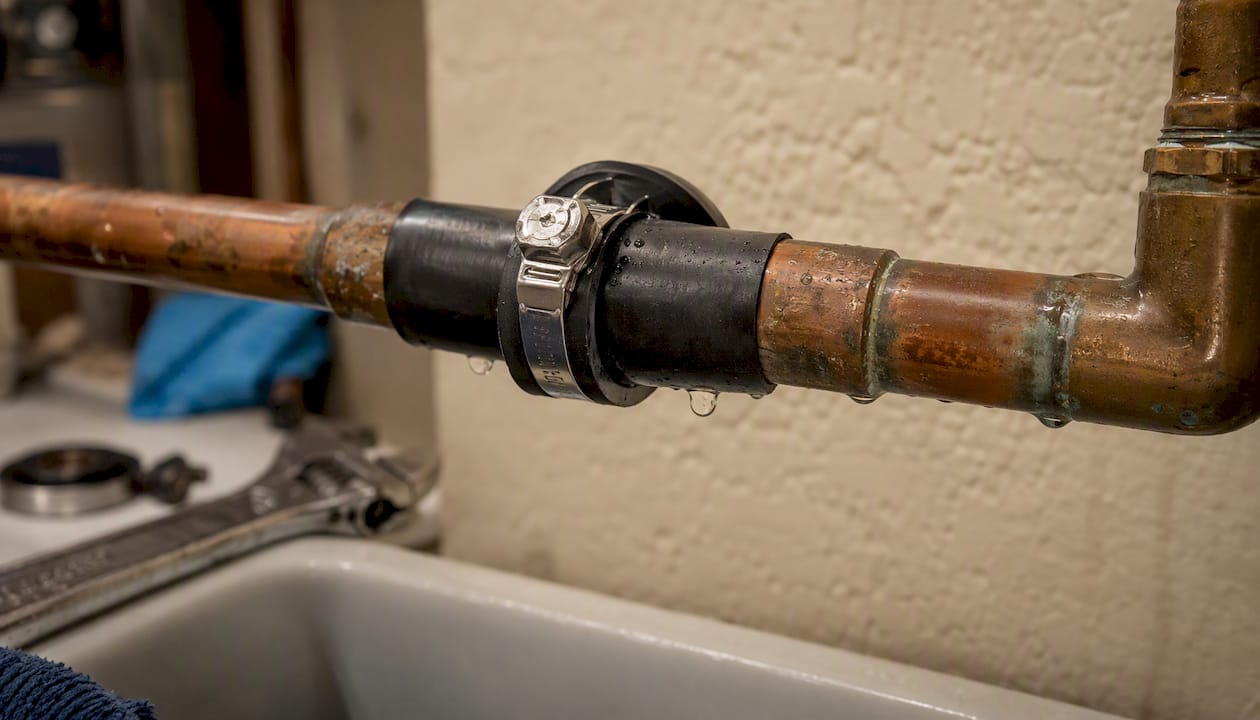
Rubber patch and pipe clamp: Cut a piece of rubber (an old garden hose section works) to cover the crack, press it firmly over the leak, and tighten a pipe clamp or C-clamp over it.
-
Epoxy putty: For small pinhole leaks on supply lines, knead two-part epoxy putty until it is uniform in color, press it firmly over the leak, and hold for the manufacturer’s cure time. This works on dry or damp surfaces.
-
Self-fusing silicone tape: Wrap tightly in overlapping layers for a short-term seal on straight pipe runs.
Safety warnings: Never use an open flame or heat gun near a leaking pipe. Do not attempt to cut or solder pressurized copper lines. These fixes are short-term measures only; a licensed plumber will replace the failed section on repair.
Pro Tip: When using a rubber patch and clamp, place a small block of wood between the clamp and the pipe. It distributes pressure evenly and reduces the risk of the clamp crushing a weakened pipe wall.
Remove water and dry the area to prevent mold
Mold can begin to grow within 24–48 hours of water exposure. That window is not a guideline; it is the hard deadline that separates a drying job from a mold remediation project.
Immediate extraction steps
-
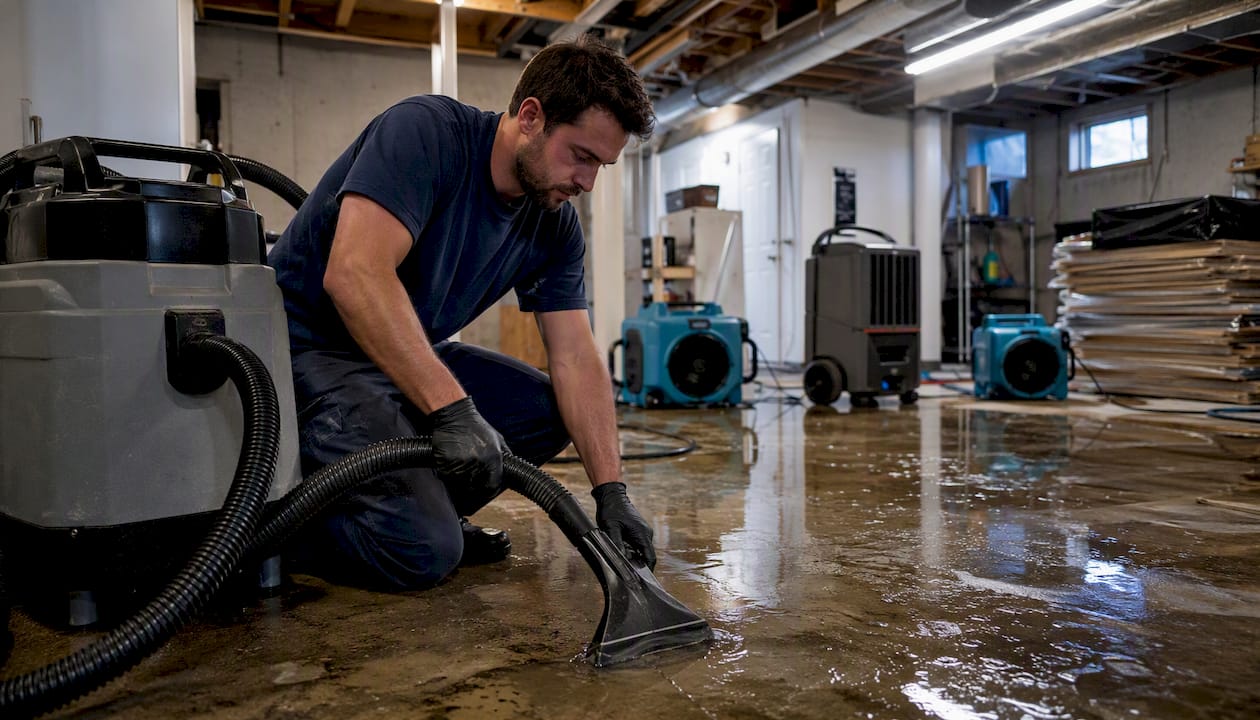
Remove standing water with a mop, towels, and a wet/dry shop vac. Work from the outer edges inward to avoid spreading contamination.
-
Pull saturated carpet and padding. Wet carpet padding almost never dries in place fast enough to beat mold. Cut it out, bag it, and document it with photos before disposal.
-
Set up box fans aimed across wet surfaces and open windows where outdoor humidity is lower than indoor humidity.
-
Run a dehumidifier continuously. Empty the reservoir frequently or route the drain hose to a floor drain.
-
Raise heat slightly (if safe and the HVAC system is unaffected) to accelerate evaporation.
When to call IICRC-certified water mitigation professionals:
-
Standing water exceeds a few inches or covers a large area.
-
Water has migrated into walls, subfloor, or ceiling cavities.
-
You do not have extraction equipment.
-
The source was sewage or contaminated water (Category 3 loss — requires protective gear and specialized disposal).
Do not use a standard household vacuum on standing water. The motor is not sealed for liquid and creates an electrocution risk.
Every gallon extracted early shortens drying time and reduces the reconstruction scope you will face later. Fast extraction materially reduces structural damage and simplifies the insurance claim process.
Document damage and contact your insurer right away
Your insurer needs a clear record of what happened, when, and what you did about it. Start documenting before you move anything if at all possible.
Photo and video checklist:
-
The burst point itself (pipe, fitting, or supply line).
-
Water levels on walls, floors, and baseboards.
-
Every soaked material: carpet, drywall, cabinetry, furniture.
-
Damaged belongings with visible water contact.
-
Timestamps on all photos (your phone’s camera does this automatically).
-
Keep the damaged pipe section or supply line for the adjuster’s inspection.
Records to maintain:
-
Plumber and restoration contractor invoices.
-
Receipts for emergency supplies (shop vac rental, fans, dehumidifier).
-
All written communication with your insurer.
-
Separate invoices for water extraction and mold remediation where possible. Mold remediation costs and coverage hinge on classification: drying and extraction often fall under dwelling coverage, while mold remediation may be subject to a sub-limit. Keeping them on separate invoices helps maximize what the insurer pays.
How coverage typically works: Homeowners policies generally cover resulting water damage from a sudden, accidental burst — soaked drywall, flooring, and contents — but they usually exclude the cost to repair or replace the failed pipe itself. Mold coverage often carries its own sub-limit. The key distinction insurers draw is sudden versus gradual: a pipe that burst overnight is covered; a slow leak you ignored for months typically is not.
Contact your insurer the same day. Most policies include a duty to mitigate, meaning you are expected to take reasonable steps to stop further damage. Delays in drying or documentation can reduce or void your claim.
When should you call an emergency plumber or restoration team?
Some situations call for a professional immediately, before you attempt any of the steps above.
Call an emergency plumber right now if:
-
Water volume is large and rising faster than you can contain it.
-
Water is near or inside your electrical panel, wiring, or appliances.
-
The water smells like sewage or is visibly discolored (contaminated water requires specialized handling).
-
You see signs of structural damage: sagging ceilings, buckled floors, or cracked walls.
-
You cannot locate or operate the main shutoff valve.
Who to call and in what order:
-
Emergency plumber first to stop the water source and assess pipe damage.
-
Licensed electrician if live circuits are wet or your panel was exposed to water. System Wide Services handles both plumbing and electrical emergencies across Los Angeles and Orange County.
-
Water damage restoration contractor (IICRC-certified) for large-volume extraction, structural drying, and mold prevention.
-
Your water utility if you suspect the damage involves the service line between the meter and your home.
What to tell the pro when you call:
-
Exact location of the break (room, floor, pipe type if known).
-
Type of water: clean supply line, toilet overflow, or sewage.
-
Whether electricity to the area is off.
-
Access instructions (gate codes, lockbox, parking).
-
Send photos by text if the dispatcher can receive them.
Emergency plumbers and restoration companies typically operate 24/7. A licensed plumber will arrive, confirm the shutoff is secure, scope the damage, and replace the failed section. A restoration crew brings truck-mounted extractors, moisture meters, and a drying plan.
Common causes of burst pipes and when risk is highest
Understanding why pipes burst helps you act faster when you recognize the warning signs.
Most common causes:
-
Freezing: Water expands approximately 9% when it freezes, generating pressure that can rupture a pipe section far from the frozen spot. Pipes in crawlspaces, exterior walls, and unheated garages are most vulnerable. In Southern California, a hard freeze below 32°F in an uninsulated crawlspace is enough.
-
Corrosion and age: Galvanized steel pipes corrode from the inside over decades. Copper can develop pinhole leaks from aggressive water chemistry. Pipes older than 50 years deserve a professional inspection.
-
High water pressure: Household supply pressure above 80 PSI stresses fittings and supply lines. A pressure-reducing valve (PRV) keeps pressure in the safe 40–60 PSI range.
-
Supply line failures: Washing machine hoses, refrigerator water lines, and toilet supply hoses account for a significant share of catastrophic household water damage claims. Braided stainless supply lines older than 10 years are a known failure risk.
-
Physical damage: A nail through a wall, a shifted foundation, or a contractor nick can weaken a pipe that fails months later.
When risk is highest: Cold snaps after a warm stretch, when pipes have not been insulated or heat has been left off in a vacant home. Also, supply line failures tend to happen without warning, often while you are away.
How to reduce your risk of a future burst pipe
Most burst pipes are preventable with a short annual checklist and a few targeted upgrades.
-
Insulate exposed pipes in crawlspaces, exterior walls, garages, and under-sink cabinets with foam pipe insulation. It costs a few dollars per linear foot and takes an afternoon.
-
Replace braided supply lines older than 10 years. Check washing machine hoses, refrigerator lines, and toilet supply hoses. Stainless-braided lines are inexpensive and far more reliable than rubber.
-
Keep your thermostat at 55°F or above when you leave the home vacant in winter, even in Southern California. Cabinet doors under sinks on exterior walls should stay open during a cold snap.
-
Test your main shutoff annually. A valve that has not moved in years may seize when you need it.
-
Check your water pressure. A pressure gauge screws onto any hose bib and costs under $15. If your reading is above 80 PSI, have a plumber install or adjust a PRV.
-
Consider an automatic leak-detection shutoff device. Products like Moen Flo and Phyn monitor flow and pressure and can close the main valve automatically when they detect an anomaly.
-
Add a service-line endorsement to your homeowners policy. Standard policies often exclude the water line between the meter and your foundation; an endorsement covers that gap for a modest annual premium.
Pro Tip: Schedule a plumbing inspection every two to three years if your home is more than 20 years old. A licensed plumber can spot corroded fittings, aging supply lines, and pressure issues before they become emergencies.
A local technician’s perspective on what we see most often
In eight years of responding to water emergencies across Cerritos, Long Beach, Torrance, and the surrounding cities, the pattern is consistent: the homeowners who limit their damage are the ones who knew where their main shutoff was and turned it off within the first few minutes. The ones who face the largest repair bills are almost always dealing with a seized shutoff valve they had never tested, or a rubber washing machine hose that was 15 years old and finally let go.
The second most common finding is a supply line failure behind a refrigerator or under a bathroom vanity. These lines are out of sight and easy to forget, but they fail quietly and can run for hours before anyone notices. Replacing them proactively costs less than $20 per line.
When a System Wide Services crew arrives at an emergency call, the first thing we do is confirm the water is off, then photograph the scene before touching anything. That documentation protects your insurance claim. We scope the damage, replace the failed section, and coordinate with restoration contractors when extraction and drying are needed. Veteran- and woman-owned, licensed, and insured, we serve 24+ cities across Los Angeles and Orange County with a 5.0 customer rating built on fast response and clear communication.
System Wide Services responds to burst pipe emergencies across LA and Orange County
When a pipe bursts, you need a licensed plumber on-site fast, not a callback window. System Wide Services provides emergency plumbing services across Cerritos, Long Beach, Torrance, Hermosa Beach, Orange, and 20+ additional cities in Los Angeles and Orange County, with 24/7 availability and upfront pricing on every job.
Our licensed, insured technicians arrive ready to stop the leak, document the damage for your insurer, and replace the failed pipe section in a single visit when possible. For jobs that require water extraction and structural drying, we coordinate directly with certified restoration contractors so you have one point of contact instead of three. Residential and commercial properties both qualify. If you are in Long Beach or anywhere in our service area and water is actively flowing, call us now to get a technician dispatched. You can also book online at systemwideservices.com for non-emergency follow-up work including post-flood drywall repair and restoration.
Sources
These authoritative resources support the guidance in this article and are worth bookmarking before an emergency occurs.
-
Insurance Coverage for Mold Following a Pipe Burst: US Market Guide – Insurance Curator
-
Pipe Burst Home Insurance: What’s Paid vs Denied 2026 | Coverage Classroom
FAQ
Is a burst pipe considered an emergency?
Yes. A burst pipe is a plumbing emergency because water flow can cause structural damage, mold growth, and electrical hazards within minutes to hours. Shut the main water valve immediately and call a licensed emergency plumber.
What should you do immediately after a pipe bursts?
Shut off the main water supply, turn off electricity to any affected area, open a low faucet to drain pressure, contain water with towels and buckets, and call an emergency plumber. Document everything with photos before moving damaged materials.
At what temperature do pipes start to burst?
Pipes in uninsulated spaces can freeze and burst when outdoor temperatures drop to 32°F or below, though the actual rupture often occurs as the pipe thaws and pressure releases. Pipes in crawlspaces, exterior walls, and unheated garages are most vulnerable even in mild climates like Southern California.
Should you call the fire department for a burst pipe?
Call 911 or the fire department only if there is an immediate life-safety hazard, such as water contacting live electrical wiring with no way to cut power safely. For a standard burst pipe without an electrical hazard, call an emergency plumber and your water utility instead.
Recommended
Need a hand with this? We've got you covered.
System Wide Services handles plumbing, electrical, and handyman work across Long Beach and LA & Orange County.