
Water Line Replacement Cost in Cerritos, CA (2026 Guide)
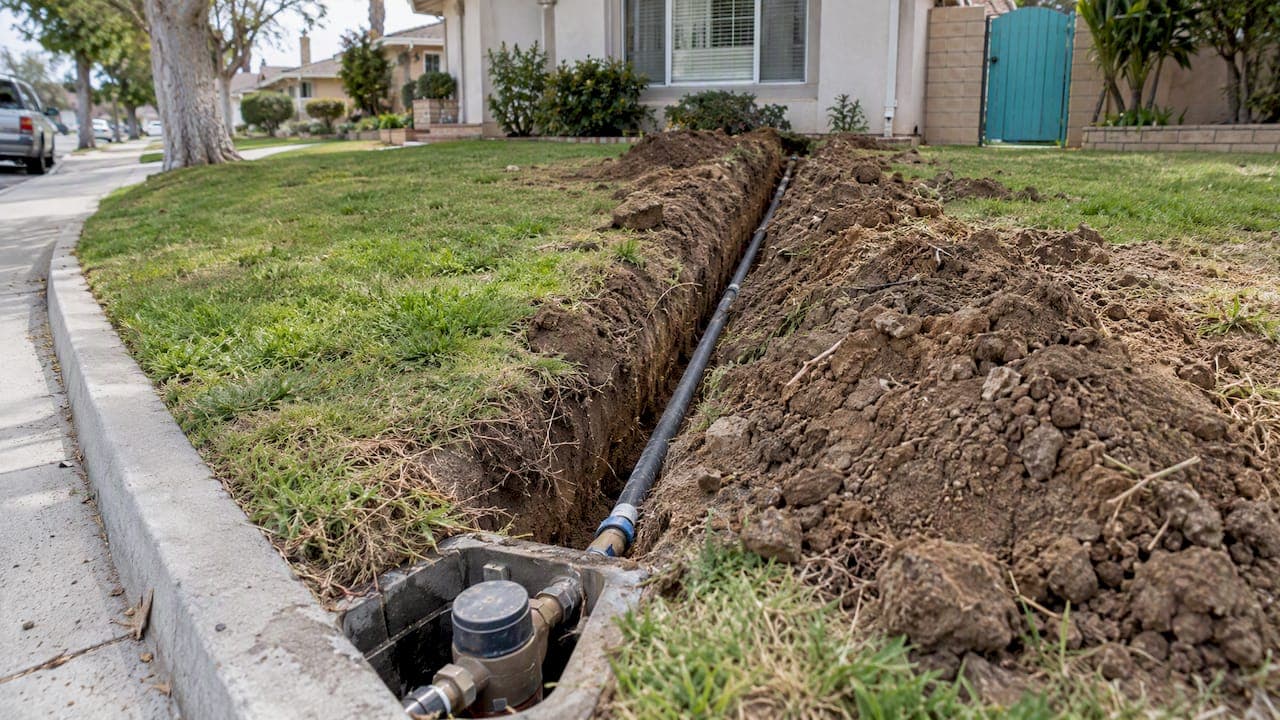
Most water line replacements for a single-family home nationally fall between $1,500 and $12,000, according to Today’s Homeowner’s cost guide. Where your Cerritos job lands in that range depends on how long the line is, how deep it runs, what sits on top of it, and whether the plumber digs a trench or uses a trenchless method. We don’t publish a flat price, because two lots on the same street can need very different work. What we can do is show you what drives the number, so any estimate you get makes sense.
This guide is written for Cerritos and Long Beach area homeowners who suspect a failing water line, or who already have a quote in hand and want to check it.
TL;DR
- National figures for replacing a main water line run from about $1,500 to $12,000, with length, depth and soil conditions setting the price.
- Surface restoration (concrete, landscaping, pavement), permits and obstructions often change the total more than the pipe itself.
- Trenchless methods cut down on digging but are not free of excavation, and they are not automatically cheaper.
- In Cerritos, plumbing changes need approvals or permits, and digging on your property requires notifying utilities at least two days ahead.
- Ask for a written, itemized estimate from a contractor with a valid state license and an active City of Cerritos business license.
Table of Contents
- What a water line replacement covers
- Typical cost ranges and how to read them
- What drives the price
- Repair or replace: how to decide
- Trenchless vs. open-trench replacement
- Permits and utility coordination in Cerritos
- Who owns which part of the line
- Signs your water line may need attention
- How to read a water line replacement estimate
- Ways to keep the cost down
- Our perspective on water line replacement
- Get a clear estimate from a local team
- Frequently asked questions
- Sources
What a water line replacement covers
Your water service line is the buried pipe that carries water from the utility connection near the street to your house. When it corrodes, cracks or develops pinhole leaks, you can repair a section or replace the whole run. Replacement means installing new pipe along the full route and reconnecting it at both ends.
This is different from a whole-home repipe, which replaces the supply piping inside your walls, and from sewer line work, which handles wastewater leaving the house. If you are weighing the inside plumbing as well, our repipe cost guide for Cerritos covers that side. For the sewer side, see how sewer line repair is priced.
Typical cost ranges and how to read them
Published figures vary by source and by region, so treat any range as a starting point rather than a quote.
| Scope | Typical range | What it means |
|---|---|---|
| Full main line replacement | $1,500 to $12,000 | Wide range driven by length, depth and soil, per Today’s Homeowner |
| Spot repair of one section | Lower than full replacement | Makes sense only when the rest of the pipe is sound |
| Replacement under hardscape | Toward the upper end | More demolition and restoration |
That national range is wide for a reason. A short run through a planter bed is a very different job from a long run under a driveway, a patio slab and a walkway. Southern California adds its own pressures: labor and permit costs run higher than in many parts of the country, and many Cerritos lots are compact, with the line passing close to foundations, block walls and mature trees.
Be cautious with any figure that promises a fixed price per foot without seeing the property. The honest answer to “what will it cost” starts with a site visit.
What drives the price
The EPA’s guidance on water distribution rehabilitation lists the cost components for replacing a line. The EPA cost document names project length, pipe diameter, the pipe product, access, excavation of pits, pavement removal and replacement, valves, service connections, traffic control and obstructions. For a house, those translate into a short list.
Length of the run
The distance from the connection to your house sets how much pipe, labor and digging or boring the job needs. A longer setback from the street means a higher price.
Depth and soil
Deeper lines take longer to reach and may need shoring. Rocky, compacted or wet soil slows excavation. This is why two similar-looking homes can get different quotes.
Pipe material and diameter
Copper has traditionally been the long-lasting choice, while plastic options such as PEX or HDPE cost less in materials. The right choice depends on code, soil and the utility’s requirements, so ask your plumber to put the material in writing and explain why they chose it.
What is on top of the pipe
This is the line item people forget. Breaking and re-pouring a concrete driveway, lifting pavers, or replacing a lawn and sprinklers can add as much to the bill as the plumbing. The EPA lists pavement removal and replacement as its own cost component, and you should expect the same in a residential estimate.

Obstructions and access
Trees, retaining walls, other utilities, gas lines and tight side yards all make the work slower. Anything that blocks the straight path adds labor.
Permits, inspections and utility coordination
Permit fees are small compared with the pipe and labor, but they are a real line item. More on that below.
Repair or replace: how to decide
A spot repair is reasonable when the leak is a single failure in otherwise healthy pipe, for example a damaged fitting or one section hit during landscaping. Replacement usually makes more sense when:
- the pipe is old galvanized steel or aging copper with repeated pinhole leaks
- you have had more than one repair on the same line
- your water pressure has dropped, or your water looks discolored
- your water bill has climbed with no change in usage
- a camera or pressure test shows wear along much of the length
The cost logic is simple. Each repair means opening the ground again, and a new section can stress the old pipe next to it. If a plumber tells you the line is failing along its length, a single repair may just postpone the full job and add to the total. A good contractor will show you the evidence, such as the leak location, the pipe’s condition or a pressure reading, before recommending either path.
Our water line repair and replacement service starts with locating the problem so you are not paying to replace more pipe than necessary.
Trenchless vs. open-trench replacement
The two methods differ in how much of your property gets disturbed.
Open trench excavates along the whole route. It gives full access and a clear view of the pipe, but it is more disruptive wherever the line crosses finished surfaces, and it generally requires more restoration.
Trenchless uses limited access pits at each end, so there is much less digging across the yard or driveway. It can protect landscaping, hardscape and mature trees. It is not excavation-free, and its price depends on site conditions, access and which technology is used. The EPA notes that base technology costs have to be supplemented by items like traffic control, obstructions, bypass piping and surface restoration, per the same EPA cost document.
A practical way to compare them:
- Ask for both options priced separately when the site allows either.
- Ask what restoration is included in each, and what is not.
- Compare the total including concrete, landscaping and cleanup, not just the plumbing line item.
Trenchless can come out ahead when the line runs under expensive hardscape. Open trench can win on a short, easy run through bare soil. Not every site allows trenchless, for example when the existing pipe has collapsed or the route has tight bends.
Permits and utility coordination in Cerritos
Permits protect you as much as they protect the city. Here is what the City of Cerritos says:
- The city requires approvals or permits for plumbing changes, including re-pipes, per its home improvement and renovations page.
- If you are digging on your property, you must notify the affected utility companies at least two days before the work starts, and excavation and encroachment permit applications can be submitted online, per the city’s excavation and encroachment permits page.
- The same page lists a $200 fee for residents for an excavation and encroachment permit. Check it for the current fee and process before your project, since the city has been moving to an online permitting system.
If your contractor says permits are not needed for a full line replacement, ask them to explain why and to confirm with the city. A reliable plumber pulls permits as a normal part of the job and builds the cost into the estimate.
One point worth knowing: the person who signs a permit application is on record as certifying that the work complies with city ordinances and state building laws, according to the city’s home improvement resources page. That is one more reason to have a licensed contractor pull the permit rather than doing it informally.
Who owns which part of the line
In general, the water utility owns and maintains the main in the street and the meter, while the pipe on the property side of the connection is usually the homeowner’s. Exactly where that boundary sits depends on your water provider and your location. Before you authorize any digging, confirm with your water provider where its responsibility ends and yours begins, and ask your plumber to note that on the estimate. It affects who pays if the problem turns out to be on the utility side.

Signs your water line may need attention
Because the pipe is buried, symptoms show up elsewhere:
- a water bill that rises without a change in habits
- a wet, soft or sunken patch in the yard or along the driveway
- low pressure throughout the house
- brown or cloudy water after the pipe has been idle
- the sound of running water when everything is off
- a meter that keeps moving with all fixtures closed
A quick check: turn off every fixture and appliance, then look at your meter. If the dial or the leak indicator keeps moving, water is going somewhere. Call a plumber and have the line tested before the ground gets saturated or the leak undermines concrete. If water is actively flooding, shut off the main valve at the house first. For urgent situations, see our guide on what to do first when you need an emergency plumber.
How to read a water line replacement estimate
A useful estimate is itemized. Before you approve anything, check that it includes:
- Scope: where the new line starts and ends, and its approximate length.
- Method: open trench or trenchless, and why.
- Materials: pipe type, diameter and fittings.
- Permits and inspections: who pulls them and who pays.
- Restoration: what happens to concrete, pavers, landscaping and irrigation afterward.
- Shutoff and timing: how long you will be without water.
- Warranty: what is covered on labor and materials, in writing.
- Payment terms: deposit, milestones, and financing if you want it.
Before signing, check that the contractor holds a valid State Contractor’s License and an active City of Cerritos business license, which the city recommends in its home improvement resources. Also confirm insurance. This contractor insurance checklist walks through what coverage to ask a contractor to prove, which matters on any job that involves digging near your home.
A few warning signs: a quote with a single lump-sum number and no detail, pressure to sign the same day, a demand for a large cash deposit, or an unwillingness to show you the problem before recommending replacement.
Ways to keep the cost down
- Get the line located precisely. Leak detection before digging narrows the dig and sometimes turns a replacement into a repair.
- Ask for two methods when possible. Compare total cost, not just the plumbing portion.
- Coordinate other work. If you plan a driveway, patio or landscape project, replacing the line first avoids tearing up new work.
- Consider the rest of the plumbing. If the inside pipes are also old, combining projects can save repeat mobilization and restoration.
- Ask about financing. We offer financing plans, which can spread out a larger project.
- Act early. A small leak left alone can wash out soil, damage concrete and raise your water bill month after month.
Our perspective on water line replacement
We see the same pattern on water line jobs again and again. Homeowners call after a bill spike or a wet spot, expecting a single number over the phone. The honest number depends on what is under the ground and what sits on top of it, so we start by finding the problem, showing it to you, and explaining your options before any digging begins.
Our plumbing, electrical and handyman work is handled by one licensed, veteran and woman-owned in-house team. That matters on a water line project, because the job rarely ends at the pipe. Concrete, drywall, tile and finishing details often follow, and you should not have to coordinate several contractors to get them done.
We believe an estimate should be clear before you commit: upfront pricing, no upsell pressure, and plain answers about repair versus replacement. We would rather you understand the job than rush a decision. If a spot repair is the right fix, we will say so. If the line is failing along its length, we will show you why replacement protects your home and your budget.
Van Castaneda
Get a clear estimate from a local team
System Wide Services is based at 20032 State Rd in Cerritos and serves 24+ cities across Los Angeles and Orange County. We handle leak detection, water line repair and replacement, sewer lines, repipes and gas lines, with same-day and emergency response and clear communication. Our customers rate us 5.0 on average.
If you suspect a failing line, start with our water line repair and replacement page to see how the process works, or visit System Wide Services to request a visit. If your leak is active and urgent, call us now, or see our emergency plumbing service.
Frequently asked questions
How much does water line replacement cost in Cerritos?
National figures for replacing a main water line run from roughly $1,500 to $12,000, according to Today’s Homeowner. Your price depends on length, depth, soil, method and surface restoration. A site inspection is the only way to get a firm number for your property.
Is a water line repair cheaper than replacement?
A spot repair is usually less expensive up front, but only when the rest of the pipe is healthy. If the line is old and failing in several places, repeated repairs can cost more than a single replacement. Ask your plumber to show you where the leak is and what shape the surrounding pipe is in.
Do I need a permit to replace a water line in Cerritos?
The city requires approvals or permits for plumbing changes, and it asks residents who dig on their property to notify utilities at least two days ahead, per the City of Cerritos. Your contractor should handle permits and tell you the cost in the estimate.
Is trenchless replacement always cheaper than digging a trench?
No. Trenchless reduces surface digging and disruption, but its cost depends on site conditions, access and the technology used. It tends to pay off when the line runs beneath hardscape or landscaping that would be expensive to restore.
How long does a water line replacement take?
Many residential jobs take a day or a few days, depending on length, method and permits. Ask your contractor for a timeline in writing, including how long your water will be shut off.
Sources
- How Much Does Water Line Replacement Cost? (Today’s Homeowner)
- Costs For Water Supply Distribution System Rehabilitation (EPA)
- Excavation and Encroachment Permits (City of Cerritos)
- Home Improvement and Renovations (City of Cerritos)
- Home Improvement Resources (City of Cerritos)
- Contractor Insurance Checklist for Landlords
Recommended
Need a hand with this? We've got you covered.
System Wide Services handles plumbing, electrical, and handyman work across Long Beach and LA & Orange County.